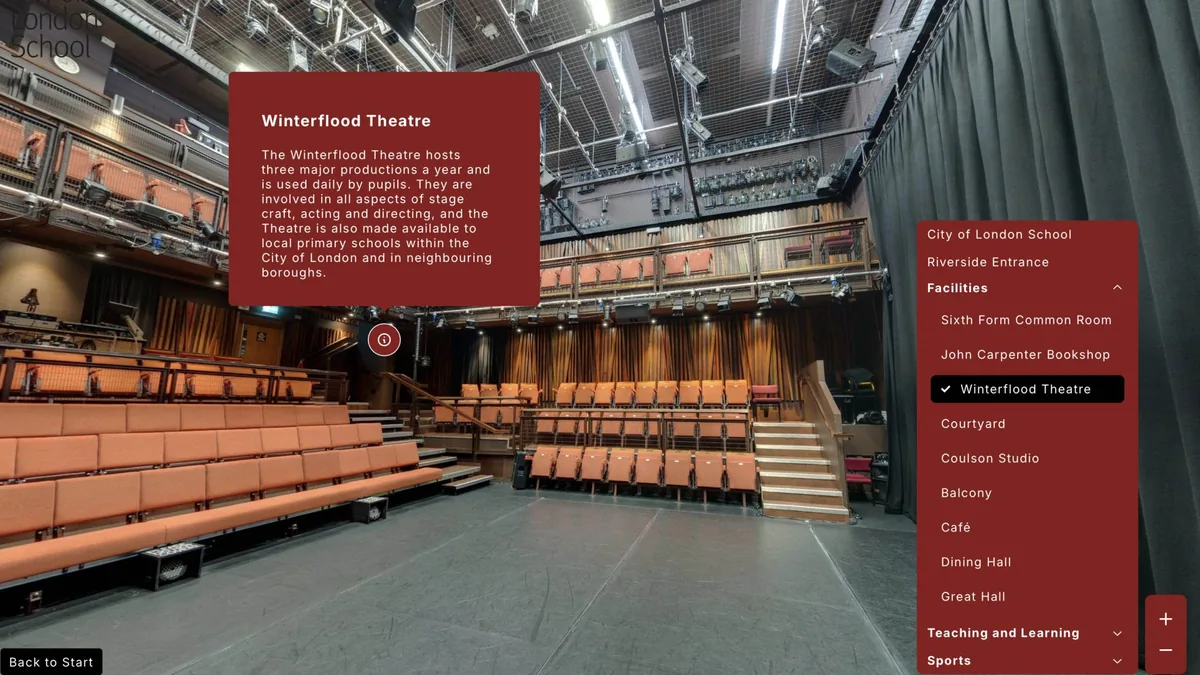
A candidate weighing up two job offers will look at your careers page, and what they usually find is a stock photograph of a laughing team around a laptop that could be any company in Britain. Meanwhile a business looking for eight desks on a flexible licence has to book a viewing just to find out whether your floor is open plan or a warren of small rooms.
Both of those problems are the same problem, which is that an office is a physical place and you are describing it with words. A virtual tour of your workspace fixes it for both audiences at once, and those two audiences are worth thinking about separately because they want different things from the same tour.
01Audience One: The Candidate
Hiring is competitive and expensive, and the moment a strong candidate is deciding between offers is the moment your workspace stops being overhead and starts being a recruitment asset.
A tour proves culture in a way copy cannot. Every careers page in the country claims a collaborative culture and a great environment. A walkthrough that shows the actual breakout space, the actual kitchen, the actual quiet room and the actual desk density either supports that claim or quietly contradicts it. Candidates are quite good at reading the difference, and the companies that benefit most from a tour are the ones whose office genuinely is a selling point.
It reduces the anxiety of a first day. Somebody accepting a job is making a leap, and a lot of unspoken worry is practical: where do I park, where do I eat, is it open plan, will I have a proper desk. A tour linked in the offer email answers those quietly, and it signals a level of thoughtfulness that candidates notice.
Remote and hybrid hiring depends on it. If you are recruiting nationally for a role that requires two days a week in the office, candidates need to assess whether those two days will be pleasant. A tour is the only way to give them that before they commit to a commute.
This is where a tour pairs naturally with recruitment photography, because the strongest careers pages combine honest images of real people with a walkthrough of the space they work in.
02Audience Two: The Client, Tenant or Landlord
The commercial case is different but at least as strong.
If you let flexible or serviced workspace, a tour pre-qualifies viewings, and viewings are the expensive part of your funnel. An enquiry that has already walked the floor knows whether the layout suits them, roughly how many desks fit, and what the shared spaces look like. The viewings that follow are with businesses who are seriously interested rather than browsing.
If you are a professional services firm, the tour does something subtler. Clients who are trusting you with money, a legal matter or a rebrand want to know you are a real, established operation. A walkthrough of a well-appointed office does more for that impression than any amount of copy about your values. I have seen this work particularly well for firms whose offices are in good buildings, and there is a clear example in my Trethowans Winchester office shoot, where the space itself carried a lot of the message.
And if you are marketing space to landlords, agents or investors, the measurement side matters. A scanned tour lets someone take rough dimensions themselves, check whether a partition would work, or plan a fit-out without a second visit. That is the practical advantage of a 3D scan with measurement tools over a set of panoramas, and for anything involving space planning it is usually the format I recommend. If you would rather weigh the options up properly, I have written about picking the right format for an office.
03What to Capture in an Office
Offices are easy to shoot badly, because the temptation is to photograph the impressive parts and skip the rest, which then reads as evasive.
The scenes that matter are reception and the arrival experience, the main working floor at its normal desk density, meeting and board rooms, breakout and social space, the kitchen or tea point, any quiet or focus rooms, and the view if you have one worth having. If you have a roof terrace, a bike store or showers, include them, because those are exactly the details candidates screenshot and send to their partner.
Desk density is the honest bit. Showing the floor as it really is, rather than at half occupancy, sets an accurate expectation. A candidate who arrives and finds the office more crowded than the tour suggested will notice, and that is a bad first day.
04The Practical Side: People and Privacy
This is the part clients ask about first. A scan cannot include people, and in an office that is a feature rather than a limitation, but it does dictate timing.
I shoot offices either outside working hours, at a weekend, or during a quiet window where a floor can be cleared for an hour at a time. In practice a floor-by-floor approach works well: your team moves off one area while I capture it, then moves back. Screens should be off or showing a neutral desktop, because a scan will happily capture a spreadsheet full of client names in legible detail. Whiteboards need wiping and confidential paperwork needs putting away. I run through all of that with you beforehand, and I will flag anything sensitive I spot in the imagery before delivery.
Most offices want stills from the same visit, and that is worth doing. Combining a tour with commercial photography on one day is cheaper than two visits and means your website, careers page and tour all look like the same building on the same day. The Climate Impact Partners office shoot is a good illustration of how the stills and the space work together.
05Where It Goes and What It Costs
On the careers page, on the offer email, on the contact or about page, on a dedicated space listing if you let workspace, and on your Google Business Profile. For serviced offices it also belongs in your reply template to every enquiry, because that is where it saves you the most time.
Cost depends on floor area and the number of separate spaces rather than headcount, and adding a scan to a photography shoot is significantly cheaper than commissioning it alone. The full breakdown lives in the cost guide.
06When an Office Tour Is Not Worth It
If your office is genuinely unremarkable, a tour will say so. There is no shame in that, and in that situation I would put the budget into photography of your people instead, which sells the team rather than the room. A tour works when the space is an asset: a good building, a thoughtful fit-out, decent light, something worth showing. If you are not sure which category you fall into, I am happy to give you a straight answer after a look round.
I photograph offices and workspaces across Somerset, Bristol and Bath, and travel UK-wide for commercial work. If you would like to talk through a tour of your office, get in touch or call me on 07545 450543.