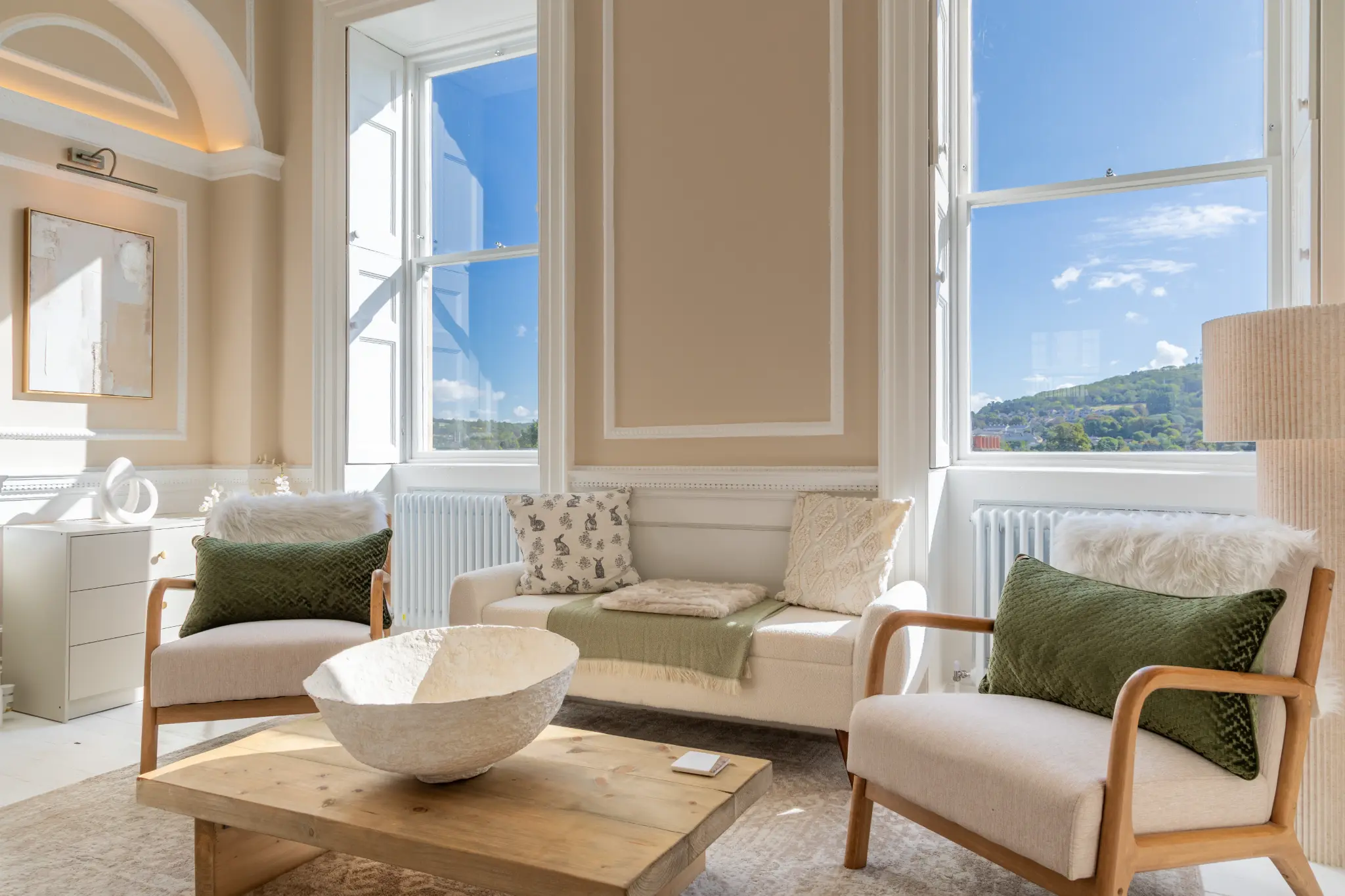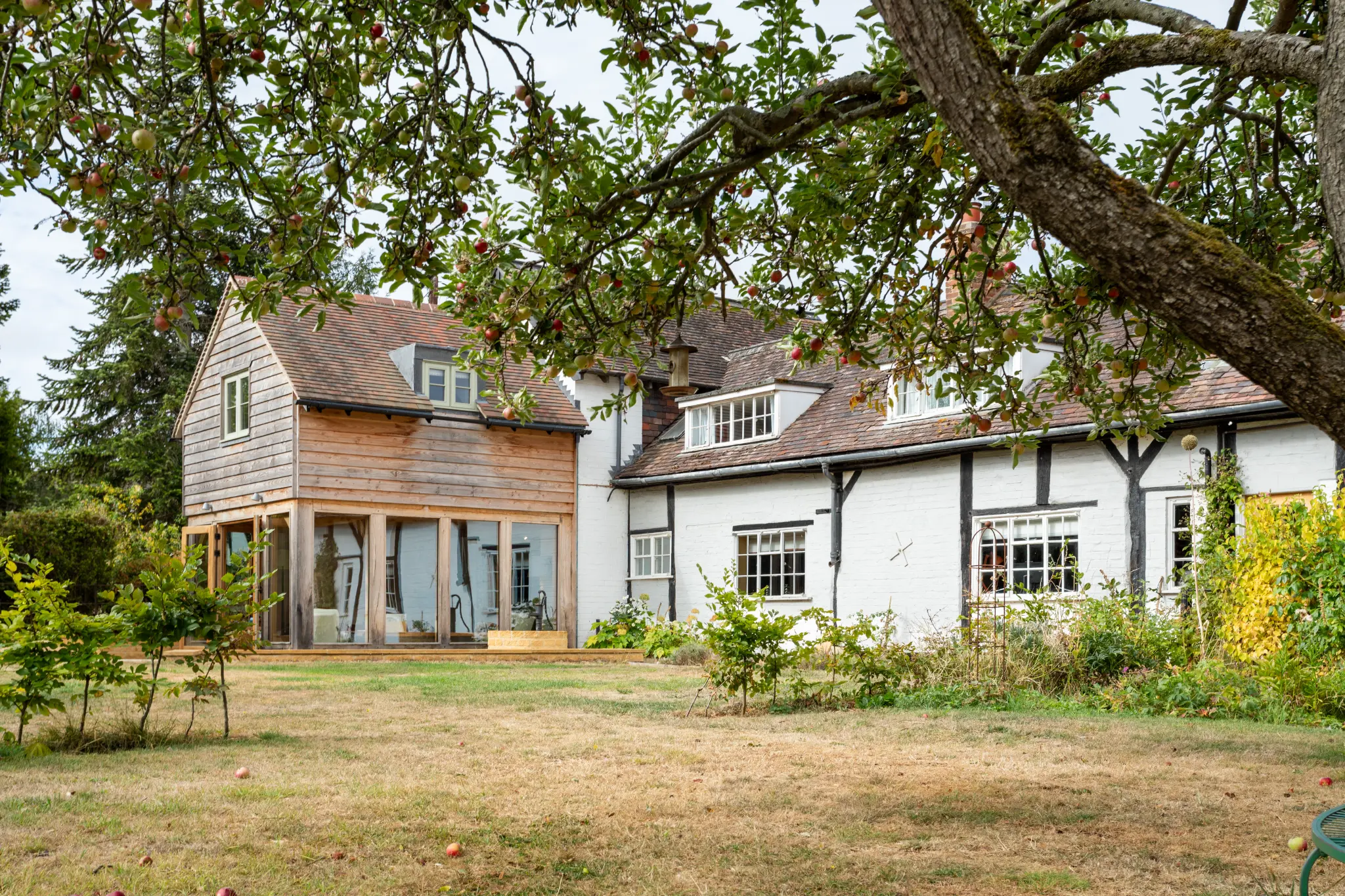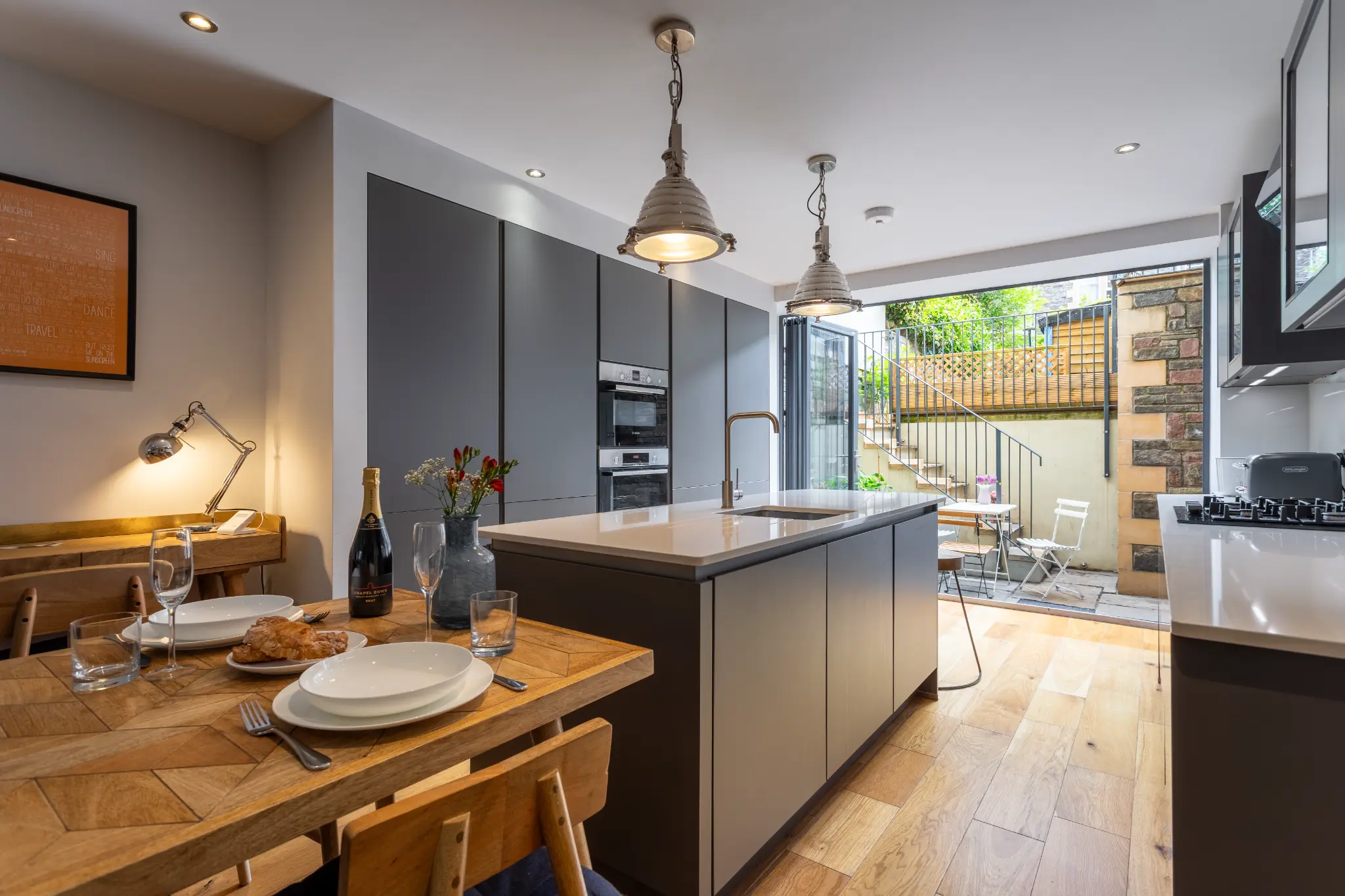
Luxury holiday let photography case study for Ochre Hill, a one-bedroom architect-designed cabin in Elton, Gloucestershire, on the edge of the Forest of Dean. The brief was to make a small property feel like a genuine escape rather than a compact floor plan. A daytime shoot processed for warmth and atmosphere, covering the exterior and meadow setting, drone aerials proving the seclusion and the surrounding countryside, the open-plan living space with wood burner, the bedroom with countryside views, the outdoor stone bath that drives direct bookings, and detail images of the design and styling. Luxury lodge and holiday let photography from The Property Photo Guy covers Gloucestershire, the Forest of Dean, Somerset, and the Cotswolds, including drone, with 48-hour delivery.
There is a particular problem with photographing a small building. Ochre Hill is a one-bedroom cabin for two people, and on paper that is a very short list of rooms: bed, sofa, kitchen, shower room, deck. A guest scrolling through a booking site does not spend long on a property that looks like it can be understood in four photographs.
The whole job, then, is to make a small footprint feel like an escape rather than a floor plan. Luxury in this sector is not about square footage, it is about how a place makes you feel when you arrive, and photography either communicates that or it does not.
Ochre Hill sits on Elton Lane in Elton, Gloucestershire, on the edge of the Forest of Dean with the River Severn below. The cabin, called Oak, is an adults-only retreat for two with a wood burner, a covered deck, a private firepit beside a pond, and a freestanding stone bath outdoors. The owners were launching to direct bookings and to listing sites, and needed a set that justified a premium nightly rate from the first frame a guest sees.
01Reading the Property Before Shooting It
Before setting up a single frame I walked the site the way a guest would, from the parking space, past the well, along the hedgeline, and up onto the deck. That walk tells you what the property is actually selling. In this case it is seclusion and the slow reveal, the cabin is not visible until you are almost at it, and then the whole valley opens up behind it.
That sequence became the spine of the shoot. Rather than photographing rooms as a list, I built the set to mirror the arrival, because that is the emotional order a guest reads images in even when they are just swiping through a gallery.
The cladding drove the technical decisions. Vertical cedar boards weather to a warm honey tone and they respond well to careful exposure and post-processing. In flat, overexposed light they go grey and dull. Shot and edited with attention to tone and warmth, they read as rich and inviting. The interiors were photographed in the middle of the day when the light coming through the open doors was strongest, and the exterior frames were processed to bring out the warmth in the timber and the meadow grass.
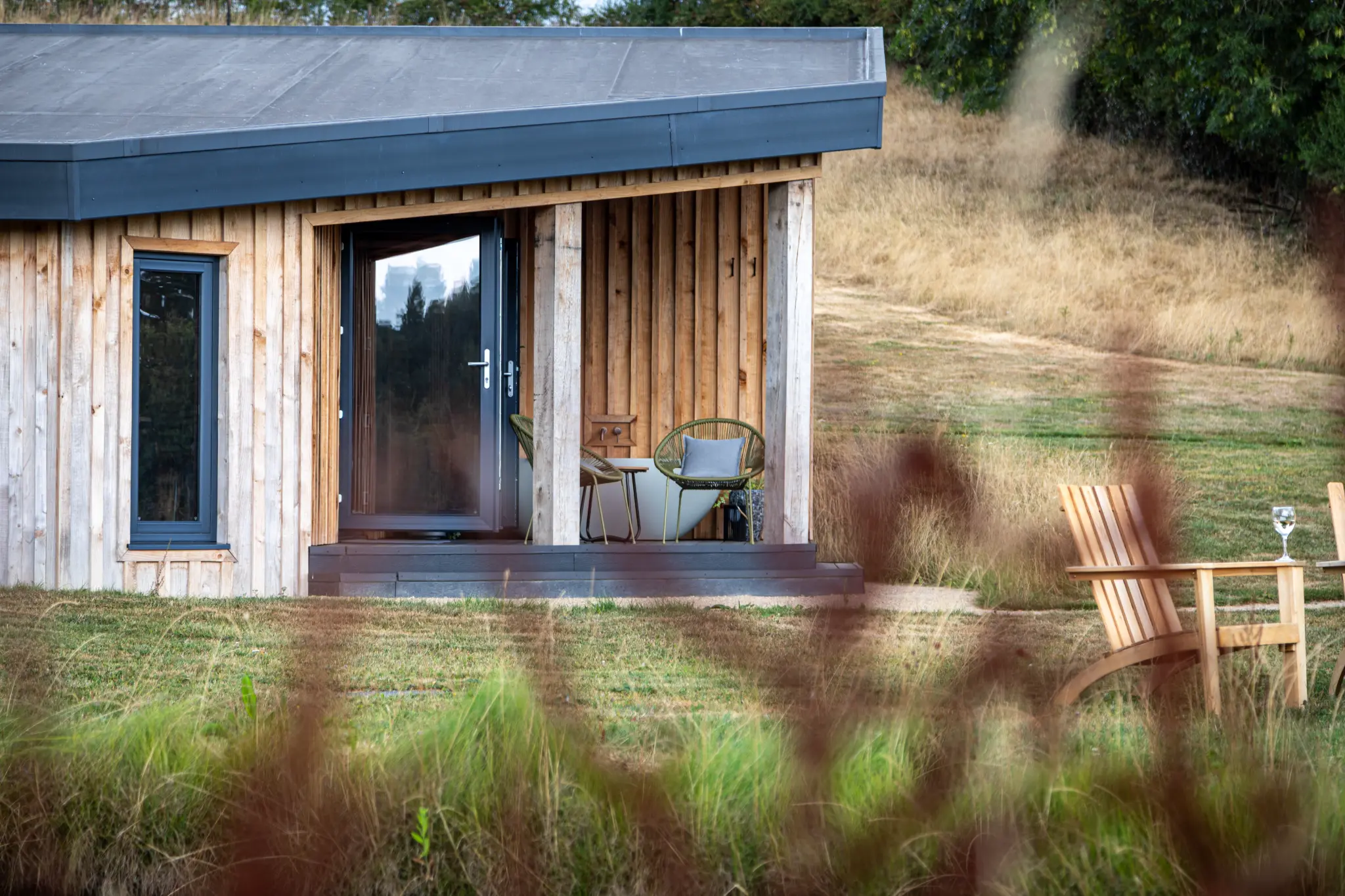
This is the frame I would lead a listing with. Composed with the meadow grass in the foreground, it does three things at once: it shows the building, it shows there is nothing else nearby, and it puts the viewer outside in the landscape rather than standing in a room. The grass being dry and tall was luck of the season, and worth using rather than tidying out of the frame. The warm, atmospheric quality in the final image came from careful post-processing rather than a specific time of day.
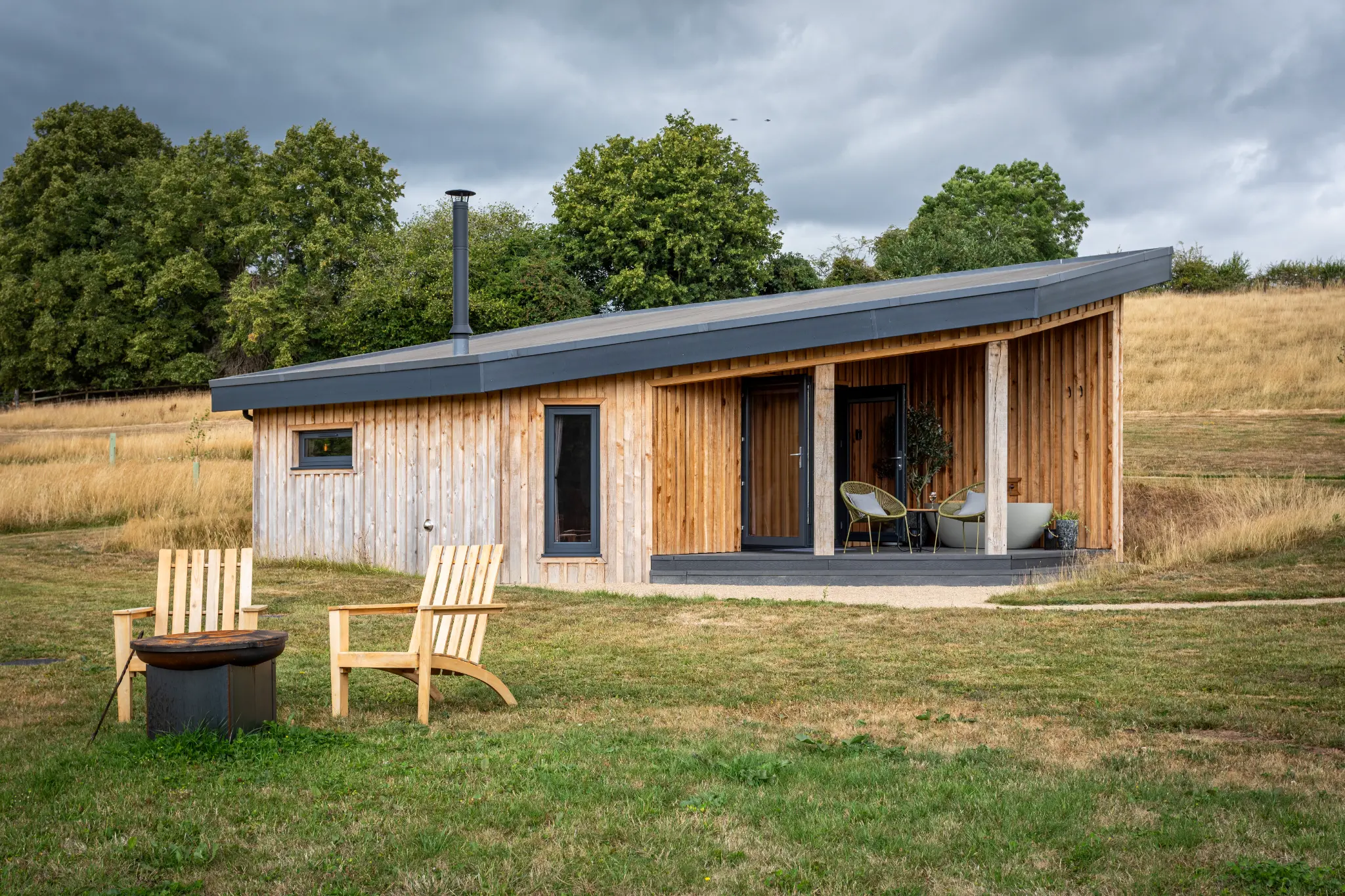
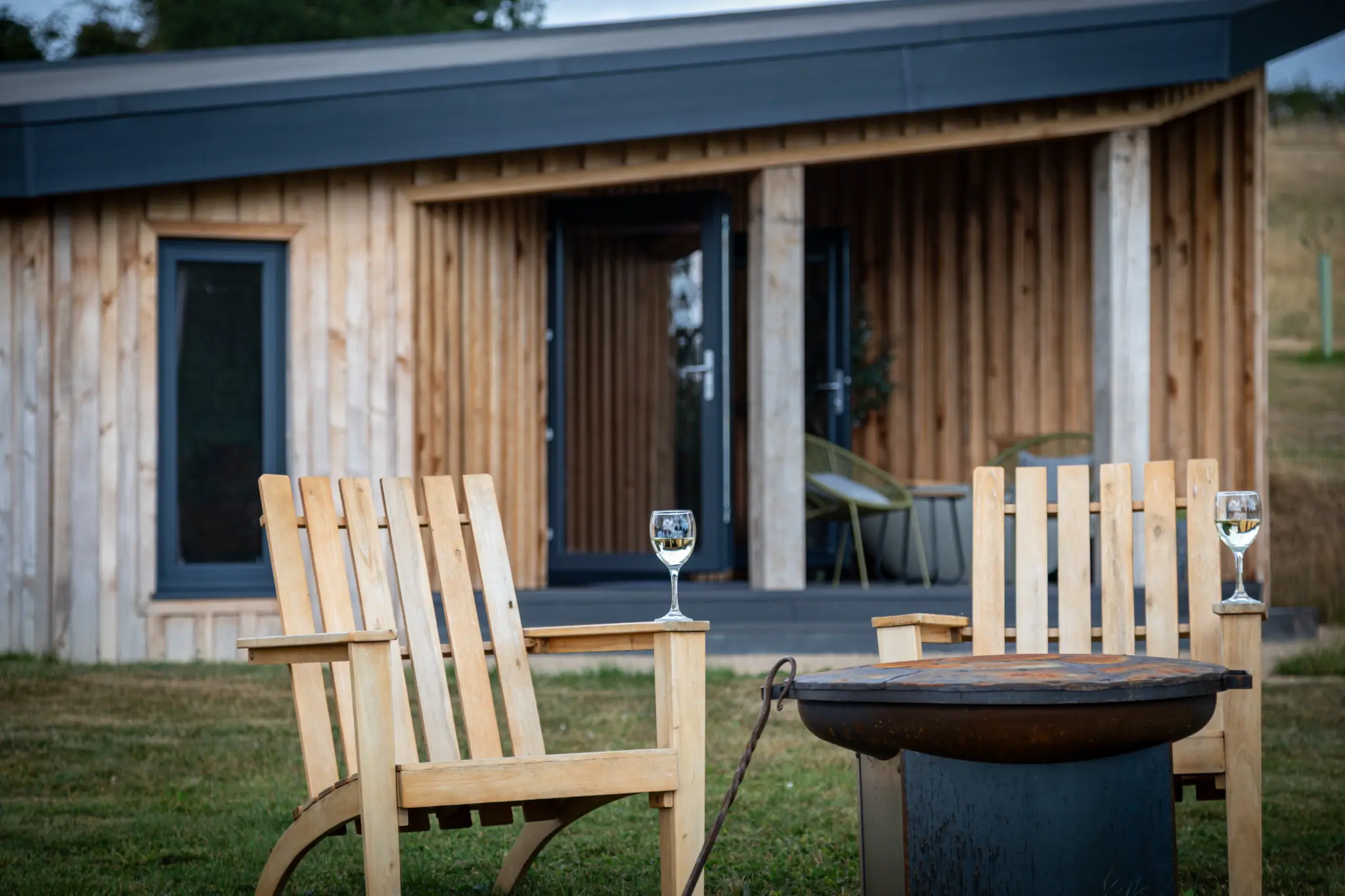
An end-on angle that gives the cabin its silhouette against the treeline and includes the firepit and chairs. Furniture in an exterior frame is not decoration, it tells the guest what they will be doing. An empty patch of grass is a lawn, two chairs and a fire bowl is an evening.
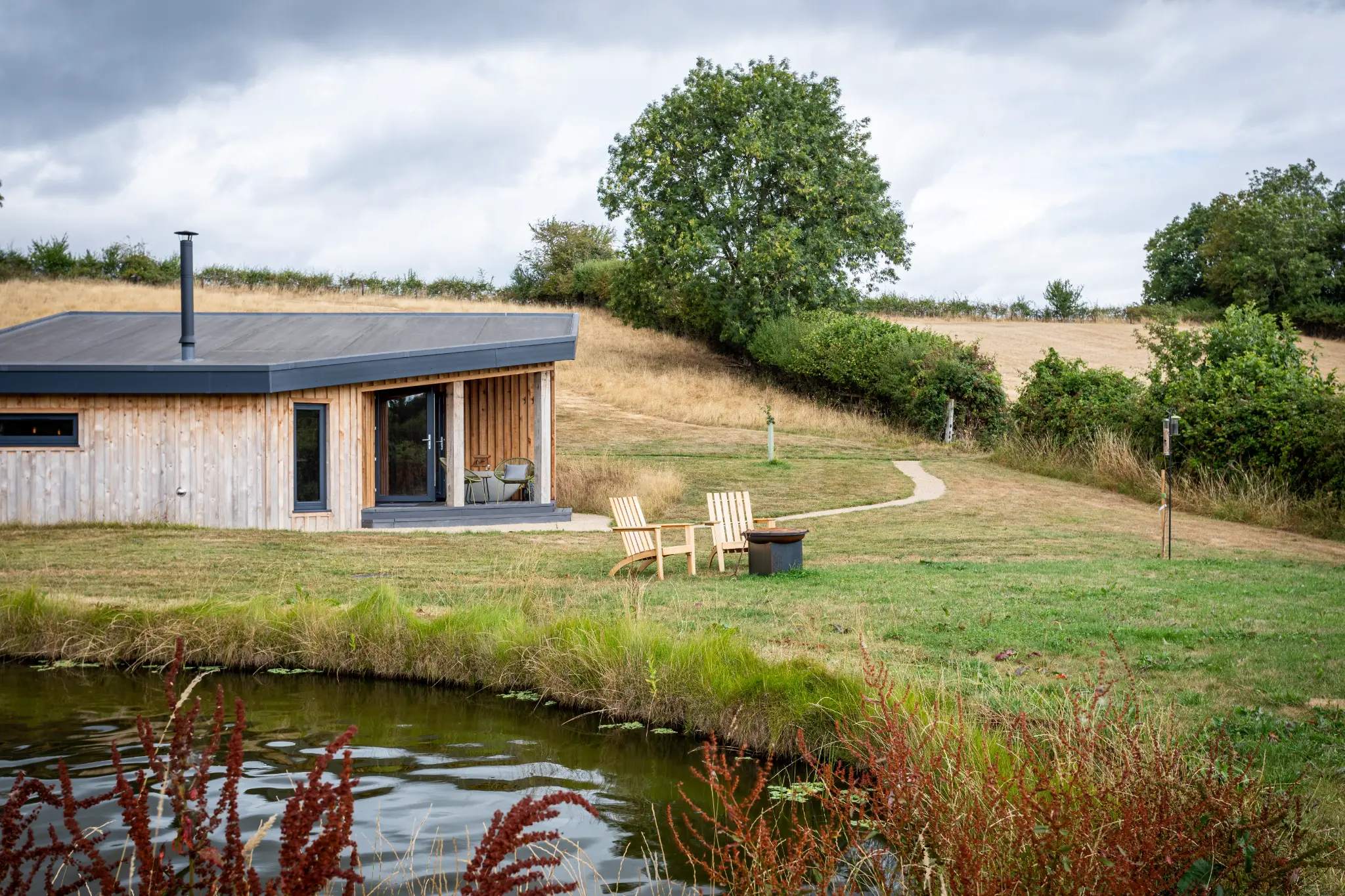
The pond is one of the property's genuine assets and it is easy to miss, because from most positions you cannot see the pond and the cabin at the same time. Finding the one spot on the far bank where both sit in the same composition took a while and produced a frame that no guest could construct in their head from the written description.
02Drone Work to Sell the Setting
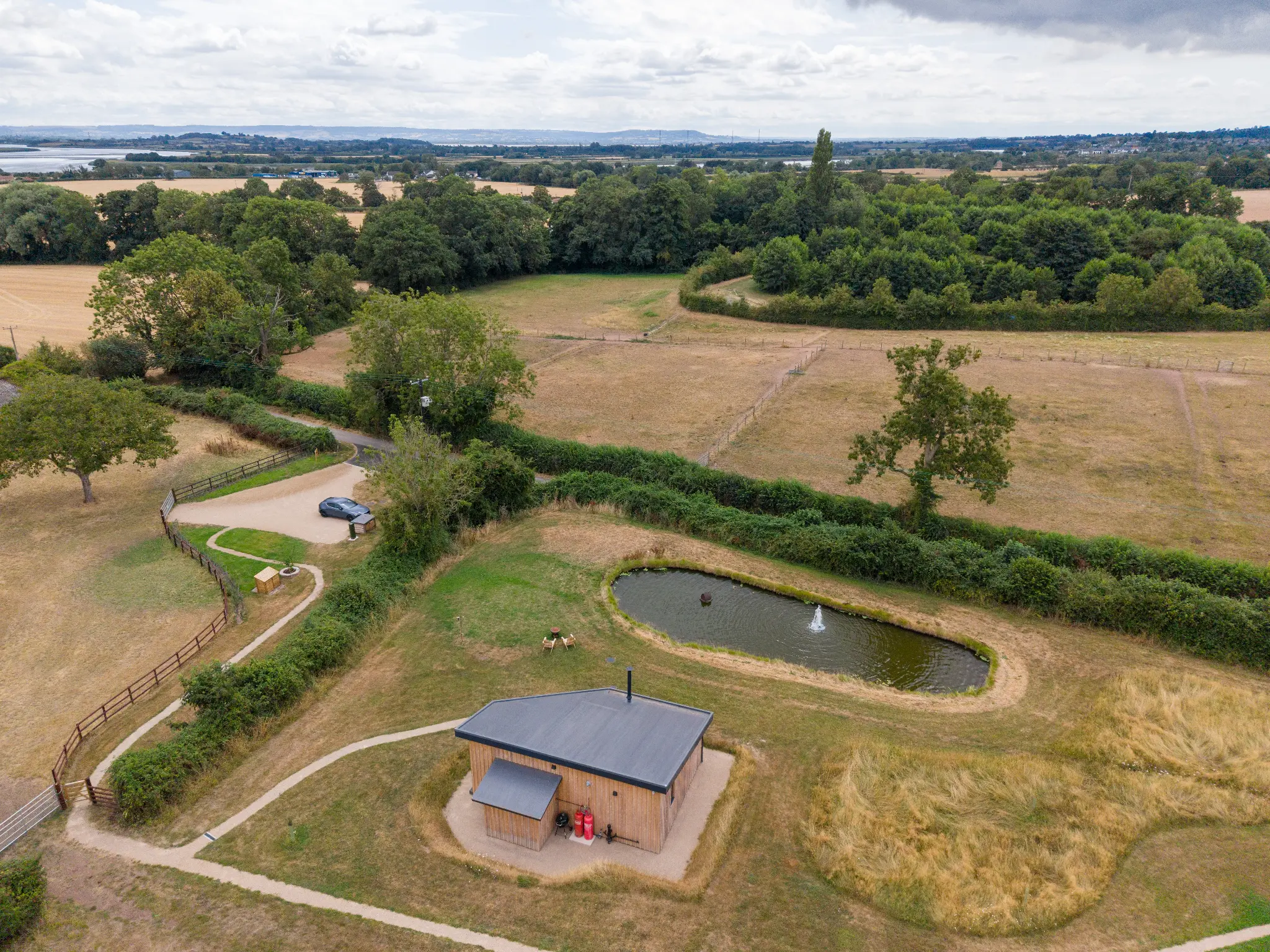
For a rural retreat, aerial photography is not a novelty add-on, it is the proof. Every listing in this category claims to be secluded. An aerial frame settles the question in a second, and the honest answer here is that the cabin sits alone in its own meadow with a pond, a footpath, and nothing else in view.
I kept the drone low and reasonably tight rather than going high and wide. High aerials make a property look small and lost. From this height the cabin still reads as the subject, while the surrounding land shows the privacy.
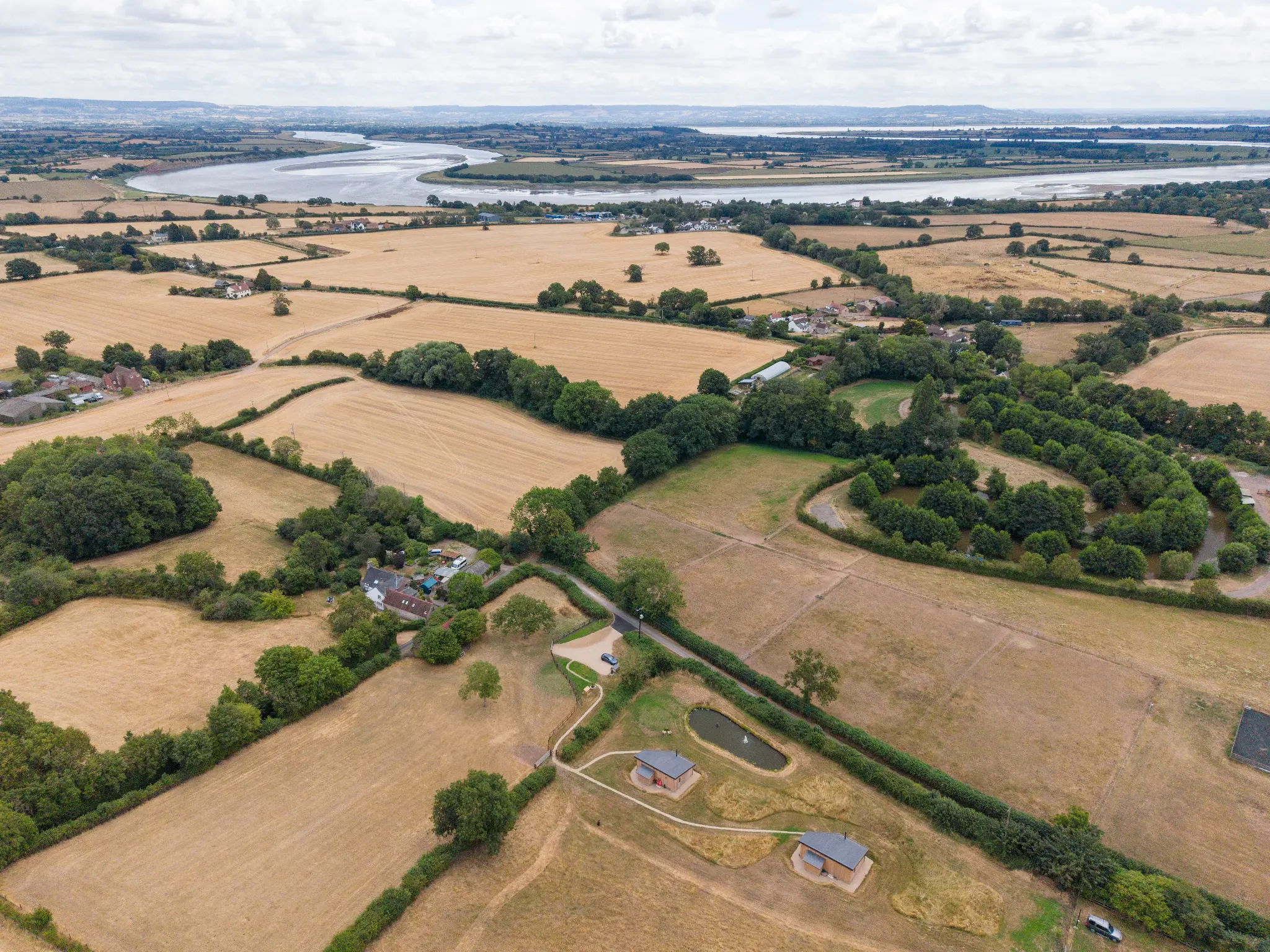
A second, wider aerial covers the context the owners talk about in their own copy, the sweep across the Severn Valley with the river on one side and the Forest of Dean on the other. Guests choosing between rural cabins are largely choosing between locations, and an image like this is doing geography that no paragraph of text can.
03The Outdoor Stone Bath, the Booking Image
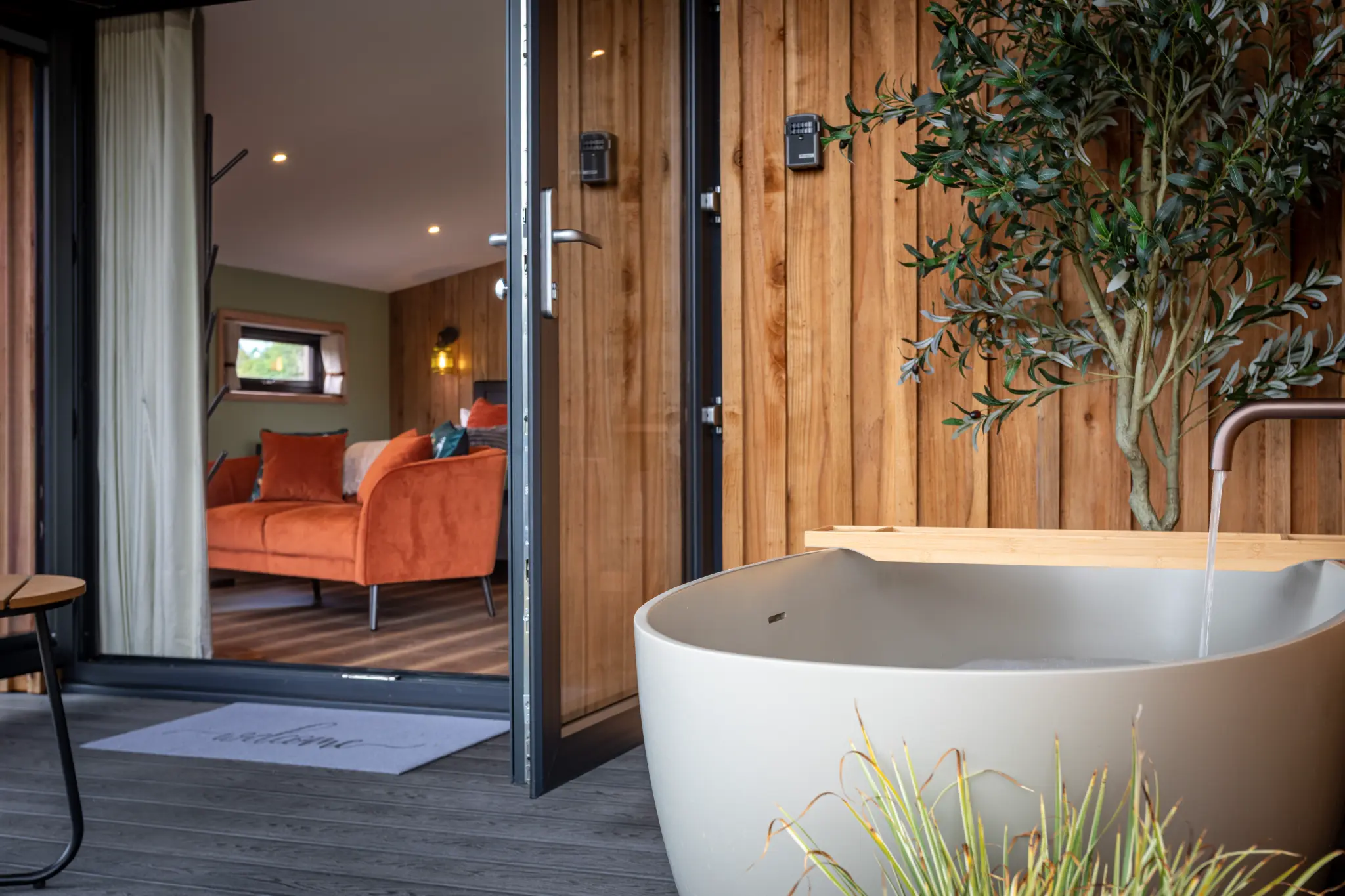
Every property in this bracket has one feature that converts, and at Ochre Hill it is unambiguously the outdoor bath. It is the thing a guest screenshots and sends to their partner. It earned the most frames of anything on the shoot.
This composition sets the bath against the cedar cladding with the olive tree beside it and the doors open to the interior beyond, so the bath reads as part of the cabin rather than a fixture in a field. The open doors also add depth and a glimpse of the warm interior, which is what stops an outdoor bath looking exposed and cold.
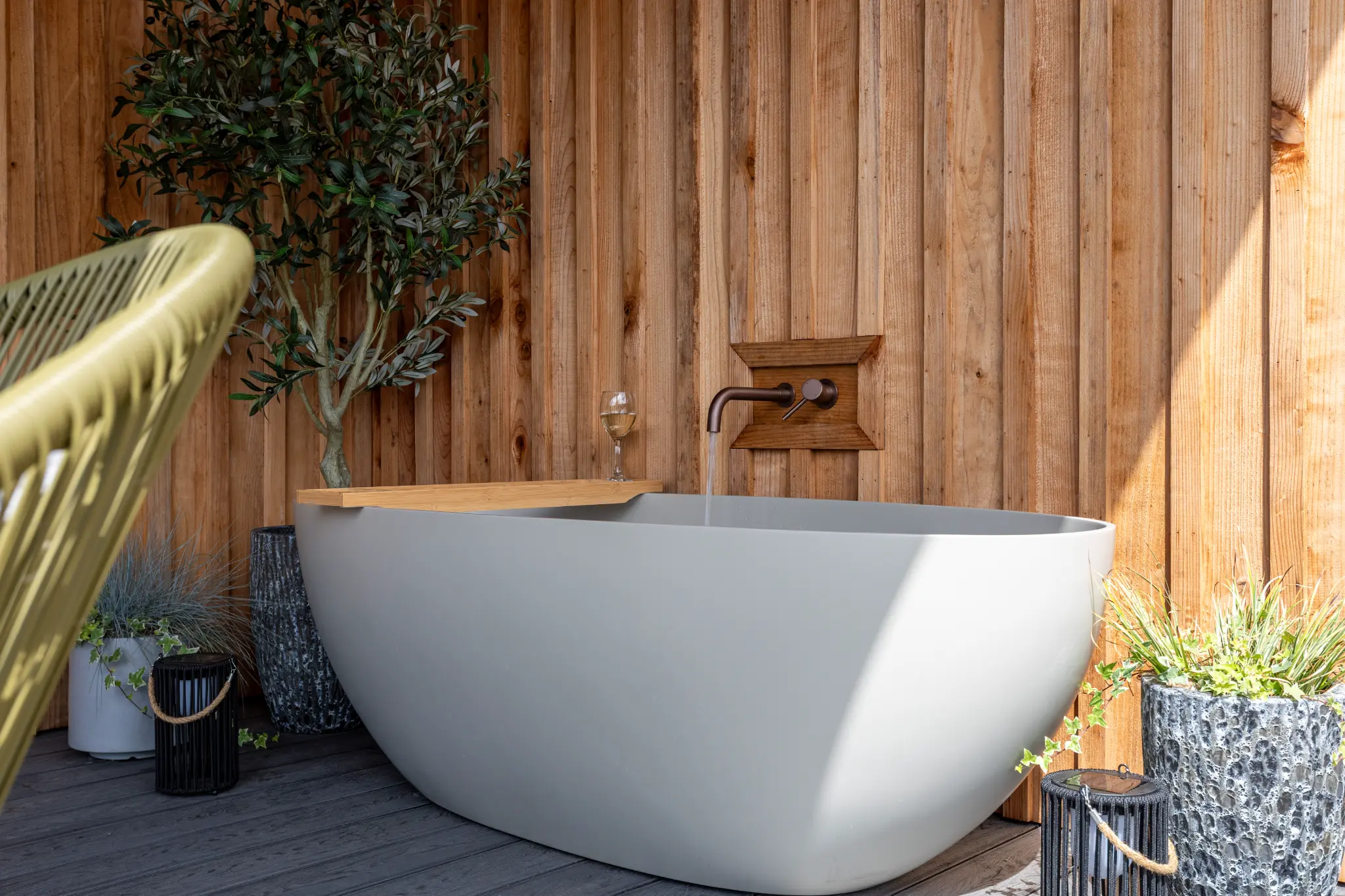
Closer, with the bath tray in place. Small styling decisions carry a lot here. A bath tray across the tub signals a long soak with a drink, and the olive tree gives the frame a Mediterranean note that lifts it away from the muddy-boots version of a countryside stay.
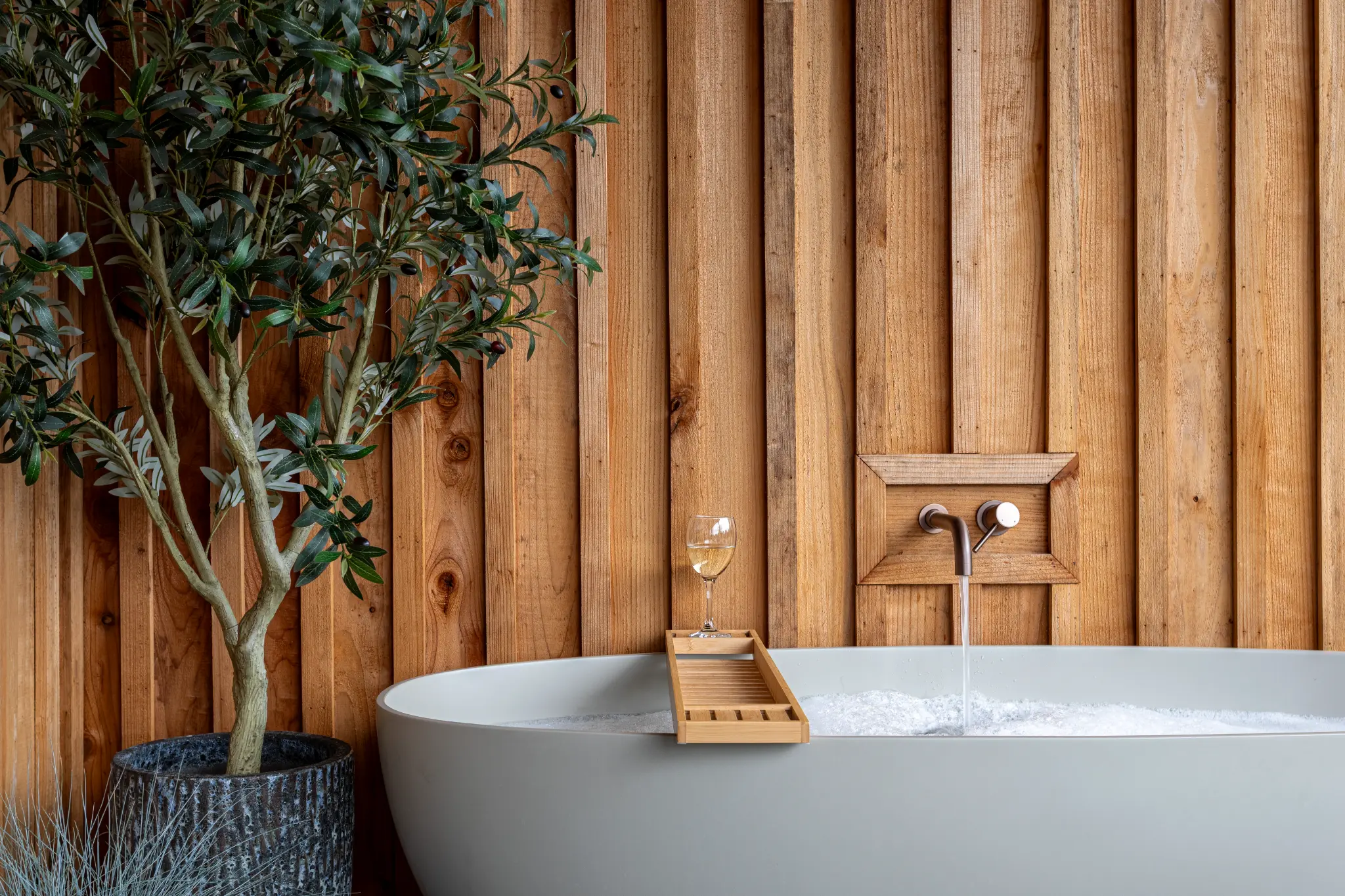
Running the water gave me movement in an otherwise very static subject. It is a small thing, but a bath that is filling implies imminent use, whereas an empty bath is just a large white object. This was shot at a slow enough shutter speed to let the water blur slightly and read as motion.
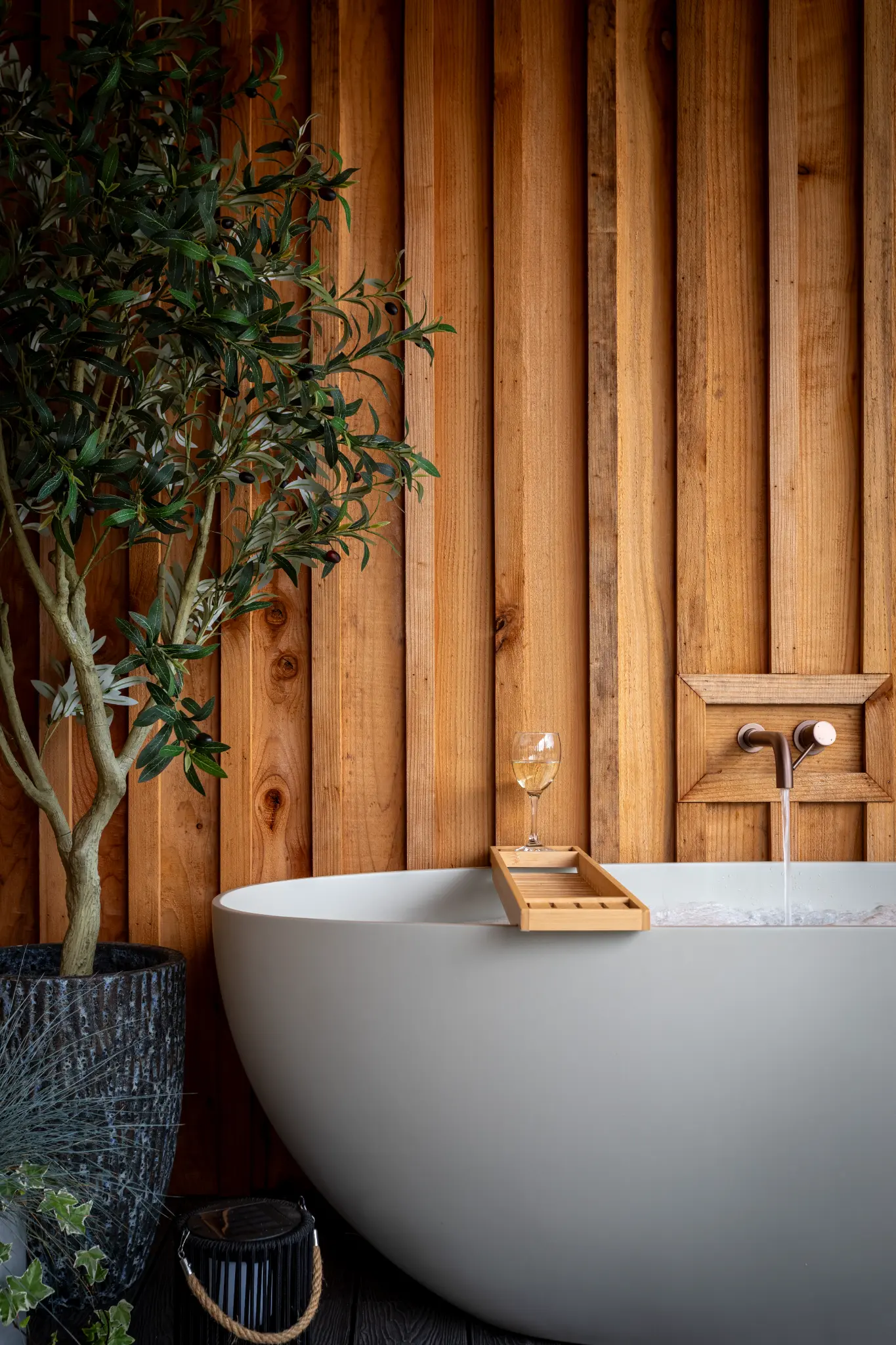
A portrait version of the same subject. Portrait frames of the hero feature are worth shooting deliberately because they are what the owners will use on Instagram and in stories, and a landscape image cropped to portrait almost always loses the top of the cladding or the base of the tub.
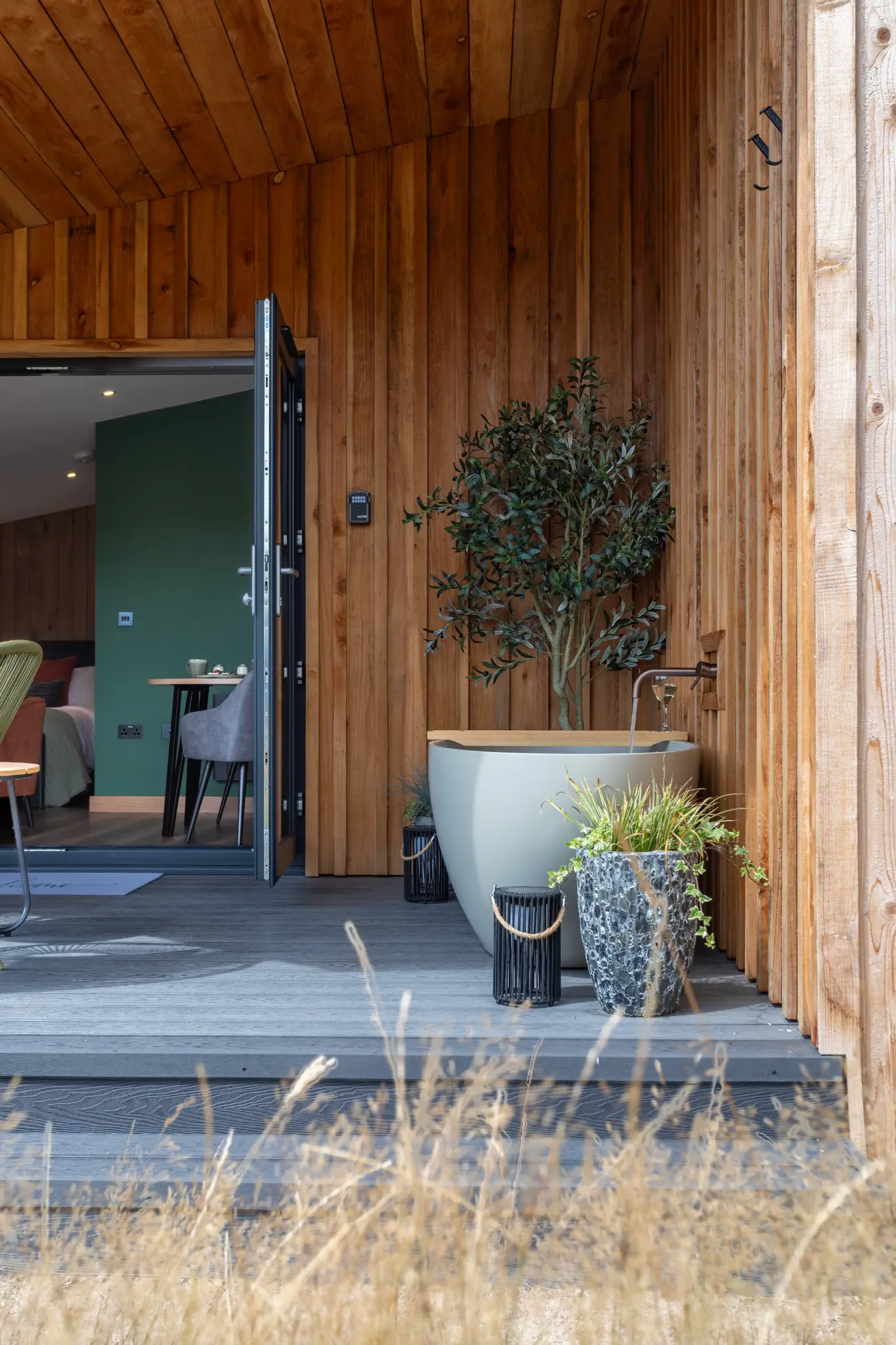
Pulling back to show the bath in the context of the deck and the meadow. Shooting a feature both tight and wide matters, because the tight frame sells the fantasy and the wide frame answers the practical question of where it actually is and how private it feels.
04The Covered Deck
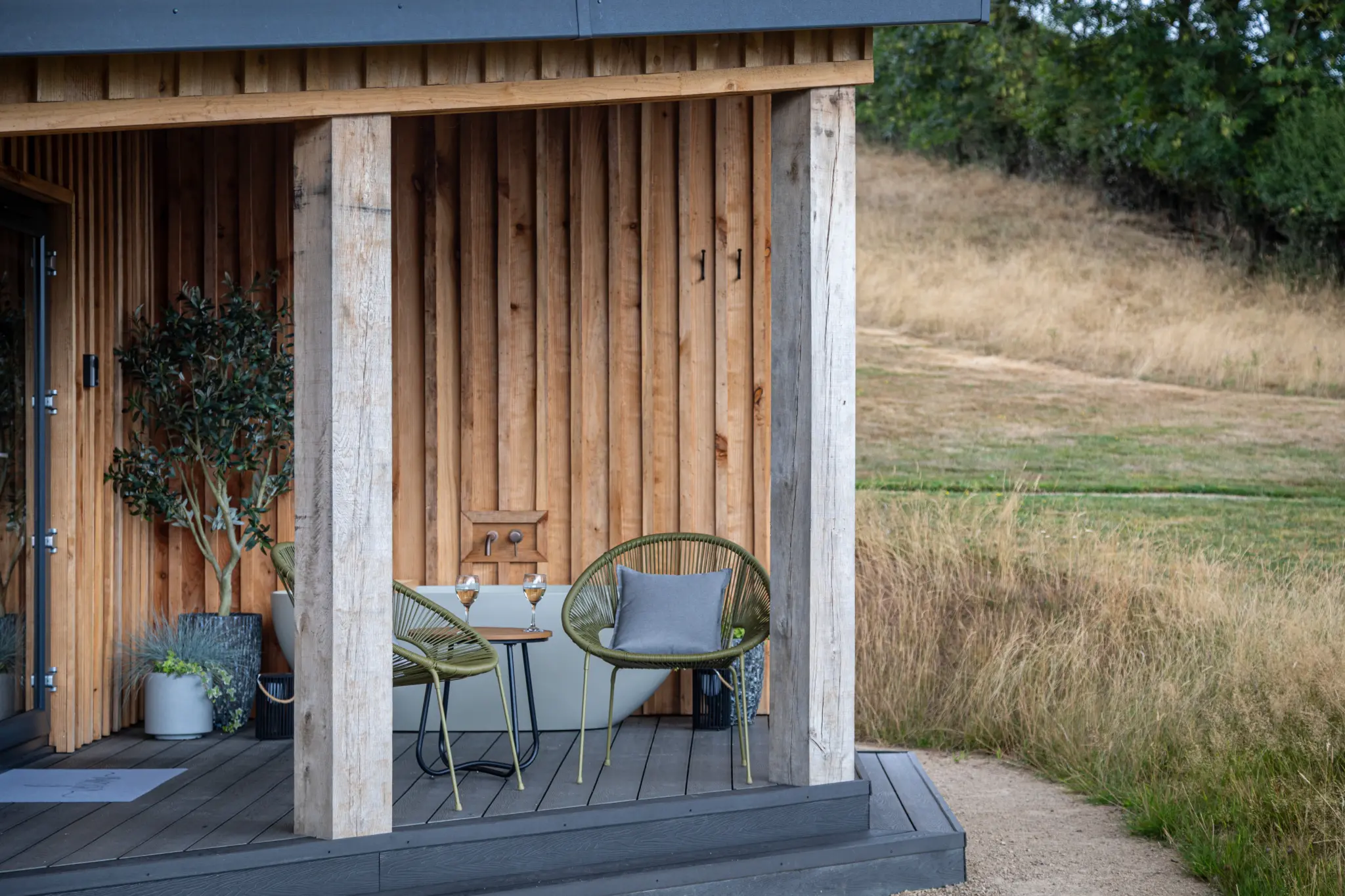
The deck is the second most important space on the property, and its appeal is that it is covered, which in this country is the difference between a usable outdoor space and one that gets used twice a year. Composing with the roof beam and post visible communicates the shelter without the viewer having to work it out.
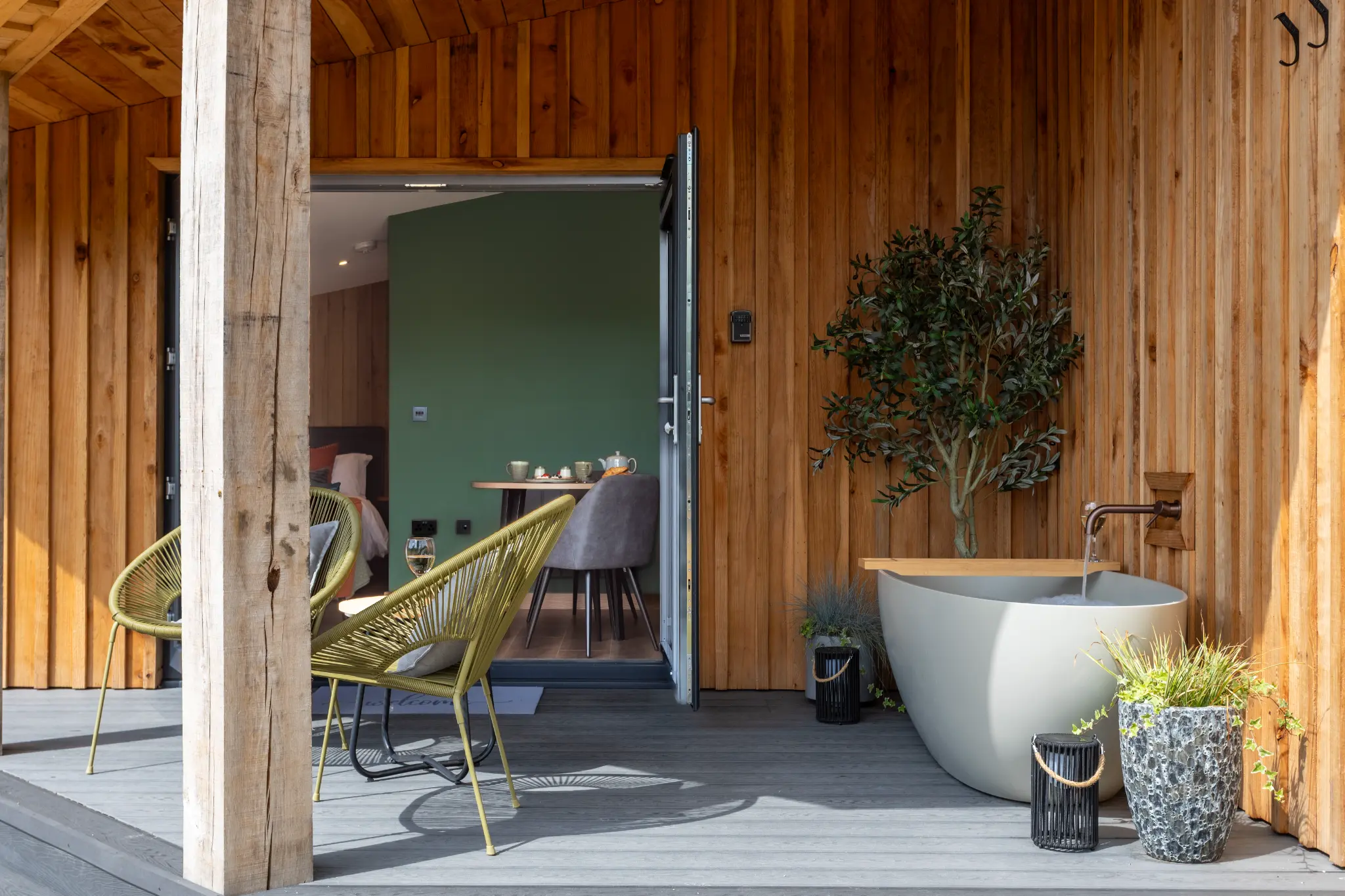
A frame that ties the deck, the open door, and the bath together. Images that show how spaces connect are consistently undervalued in holiday let photography. A guest is trying to build a mental model of the whole property, and a single frame linking three elements does more for that than three isolated shots.
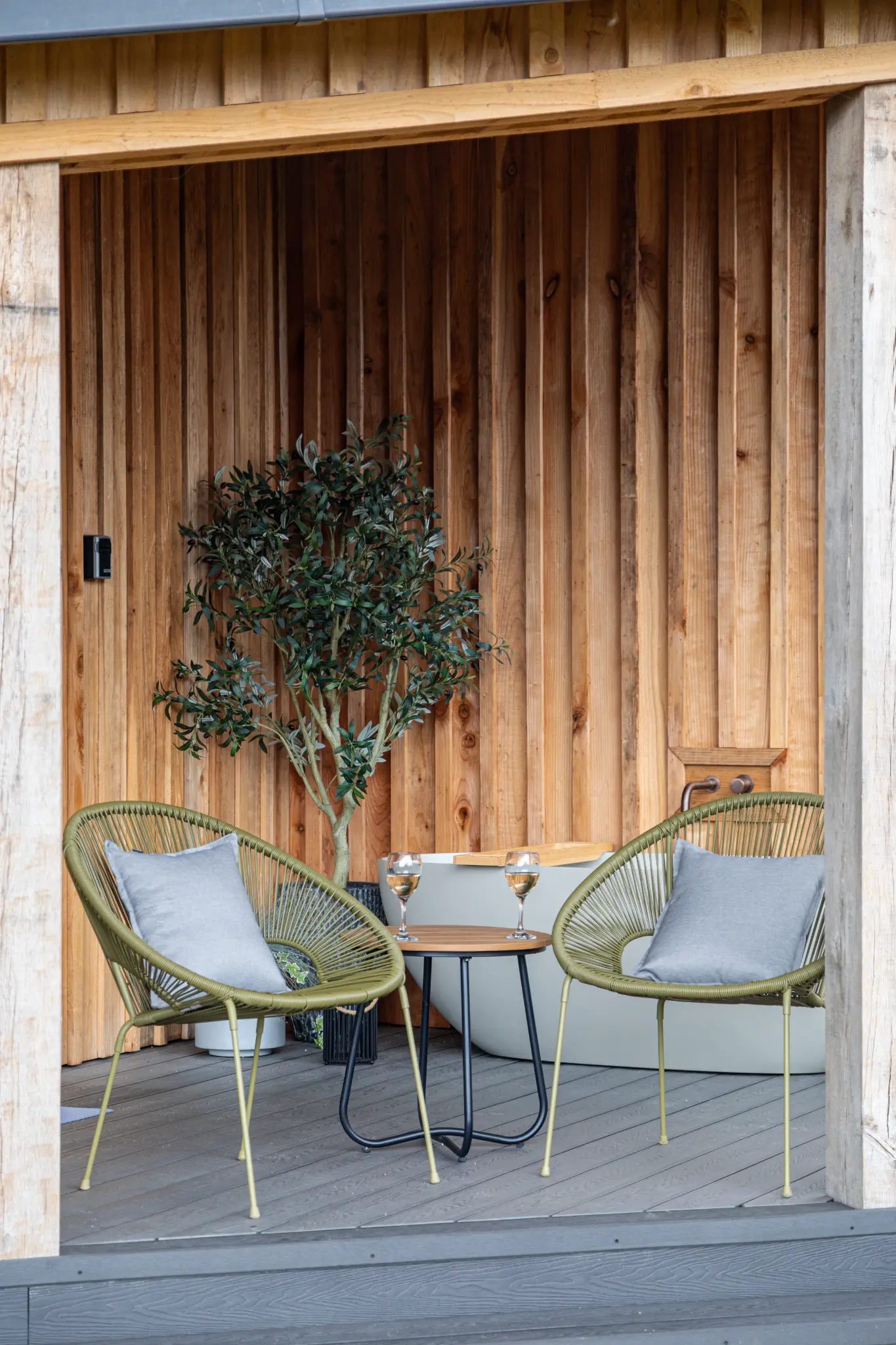
The bistro set framed portrait against the cladding. Two chairs and a small table is a very specific promise for an adults-only property, and the styling was left deliberately simple so the frame reads as calm rather than staged.
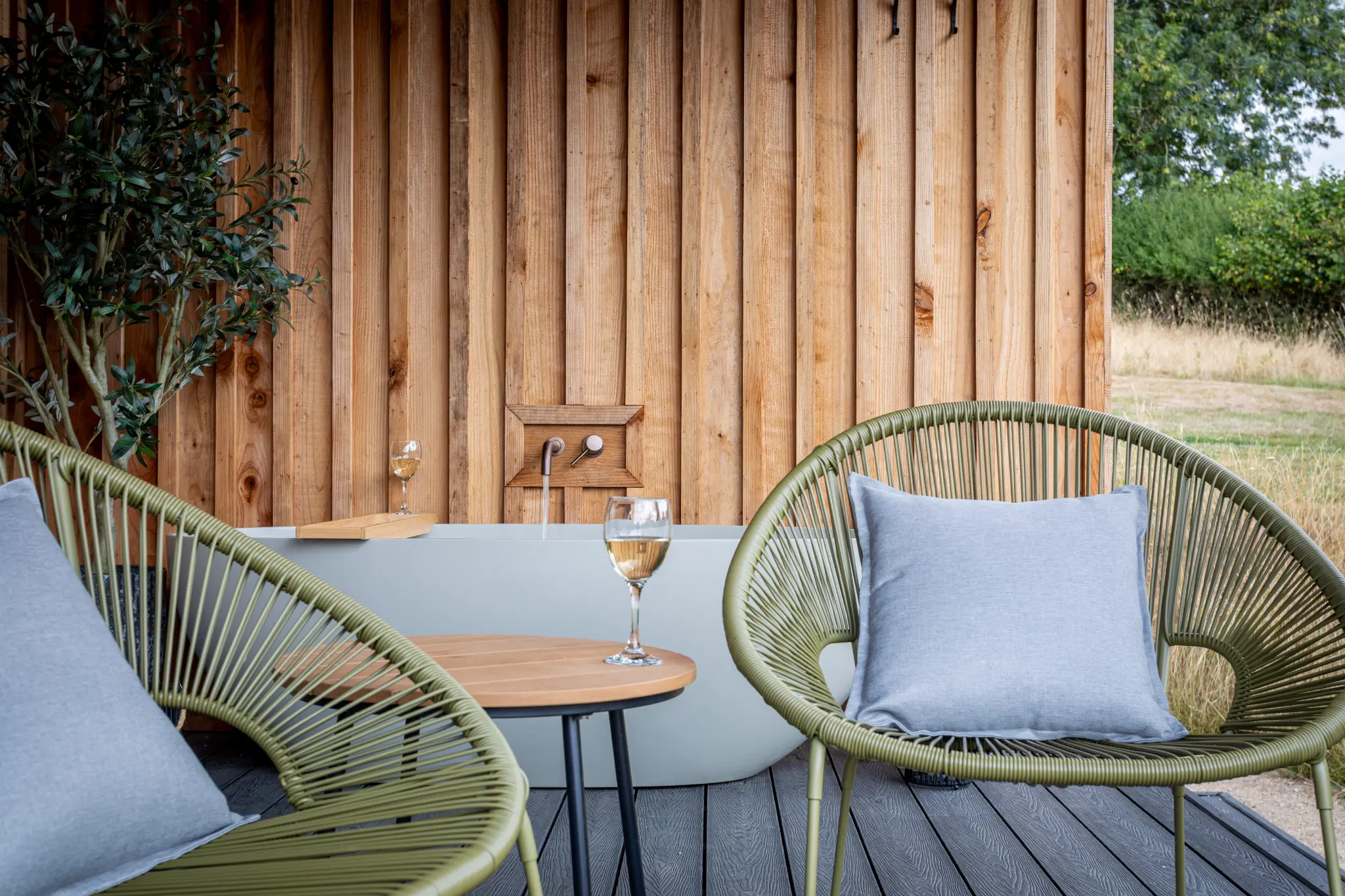
Closer on the seating, with a glass poured and cushions placed. This is the sort of detail frame that does very little for a floor plan and a great deal for a booking. It is not showing a feature, it is showing an afternoon.
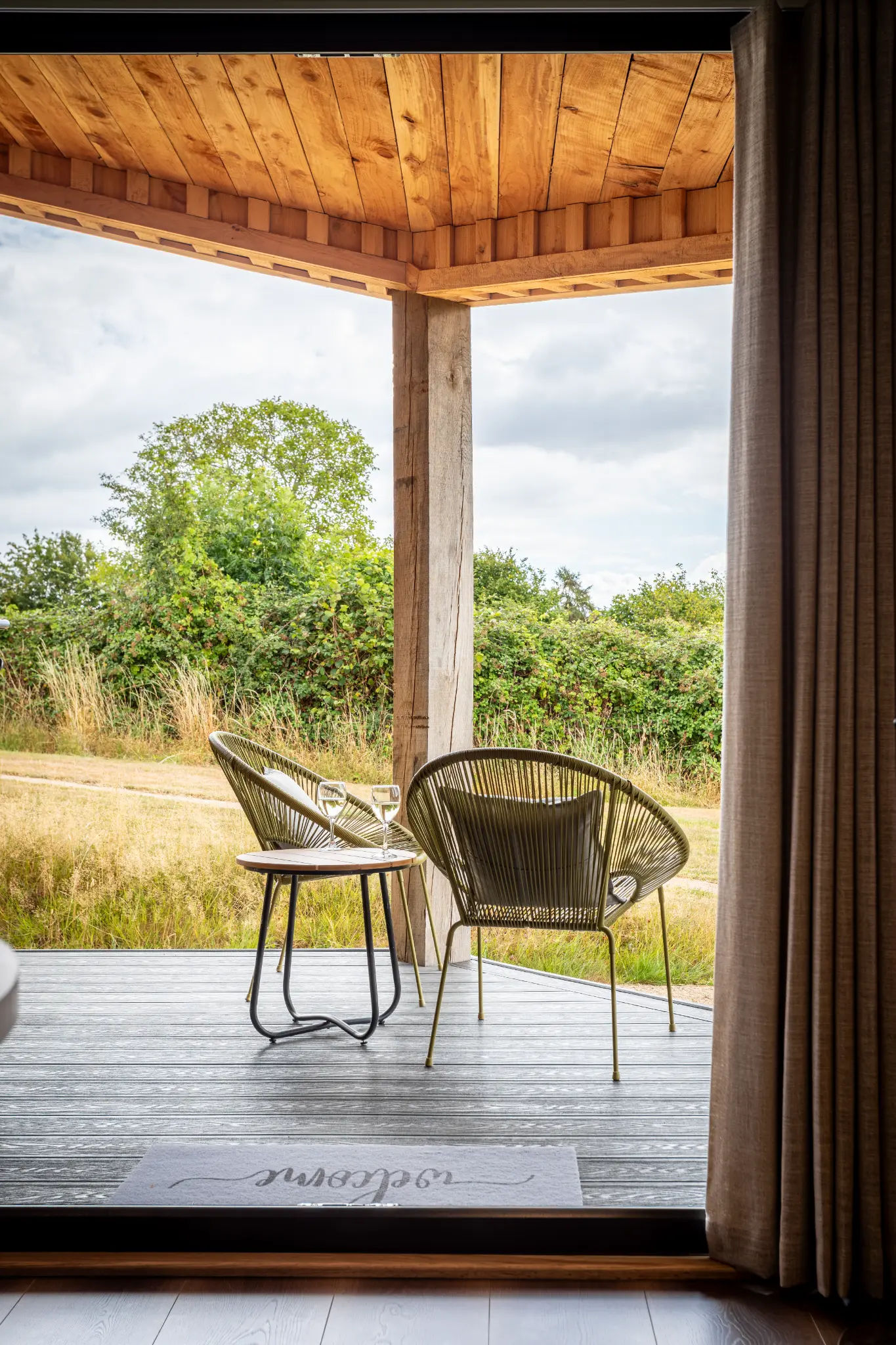
Shooting outward from under the deck roof, using the timber post and the curtain as a frame around the view. This inside-out composition is one of the most effective tools available for a rural property, because it puts the viewer in the guest's position, sitting on the deck looking at what they came for.
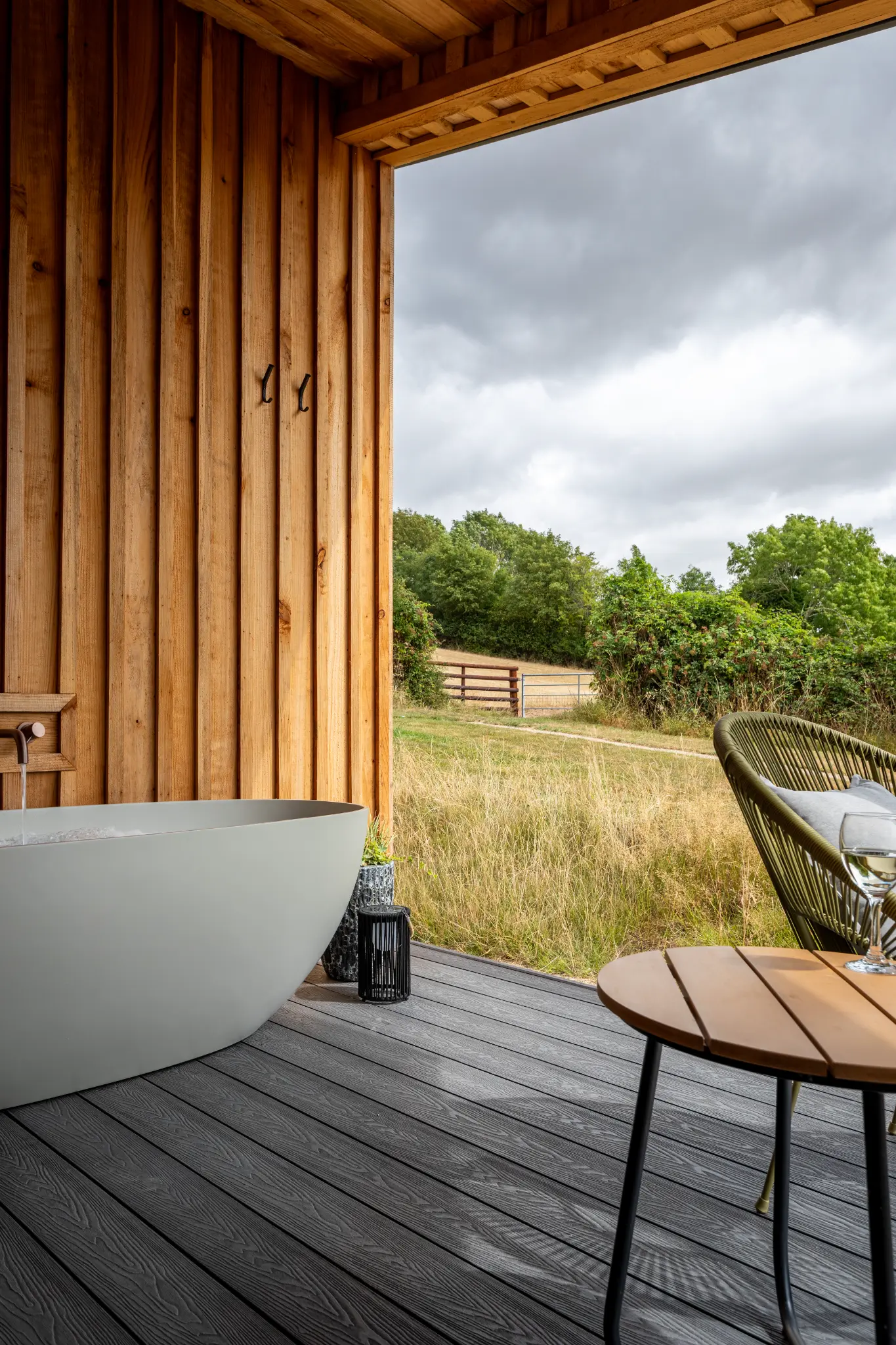
A variation on the same idea from the opposite corner, with the edge of the bath in the frame. Shooting several versions of a strong composition gives the owners options for different formats and platforms without needing another visit.
05Inside: One Room That Has to Read as Several
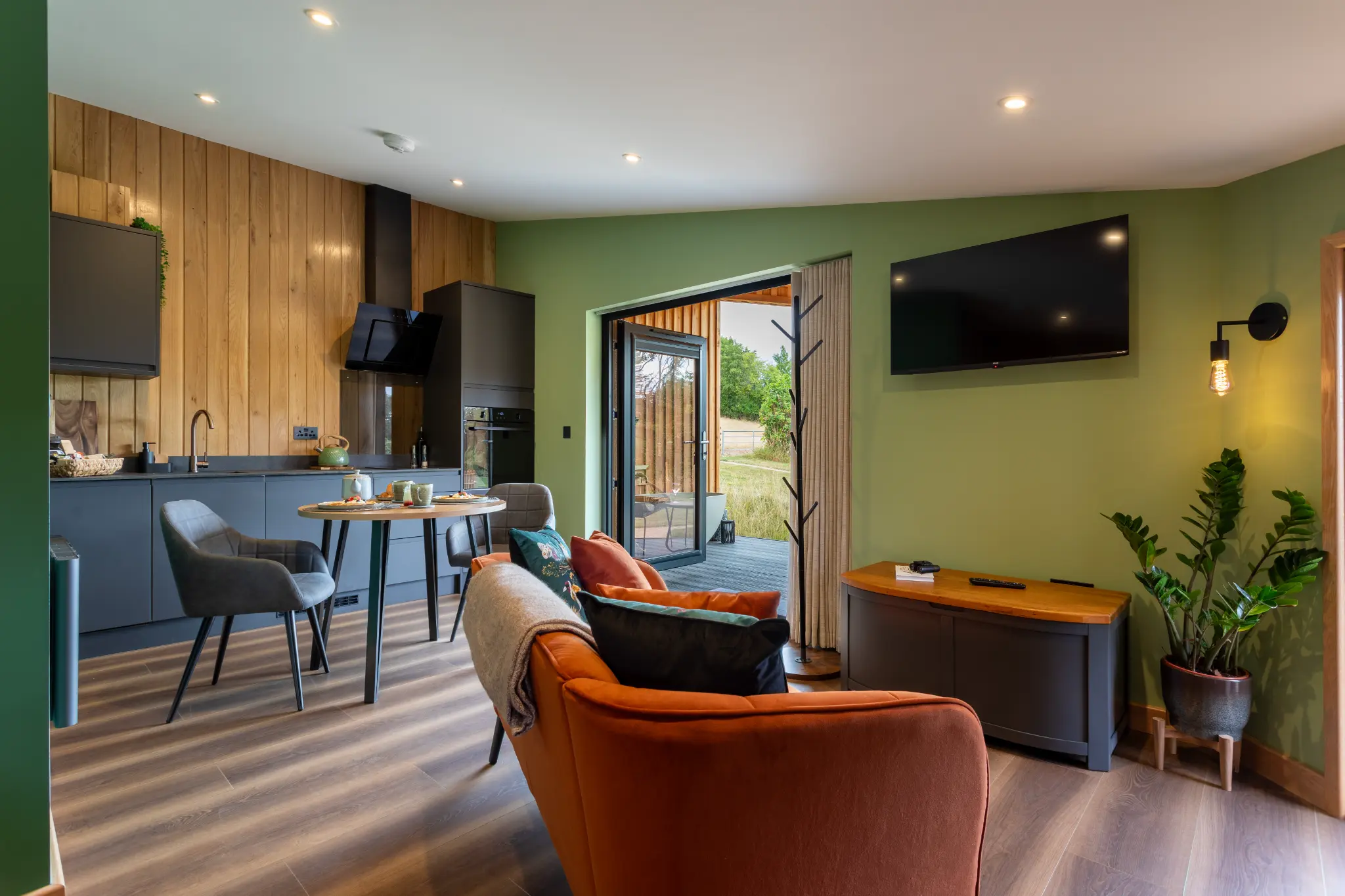
The interior is a single open-plan space containing the bed, a two-seater sofa, and a fully fitted kitchen with a dining table. The photographic challenge is that a guest needs to understand it is genuinely comfortable rather than cramped, and one badly chosen wide-angle frame can make a compact cabin look either distorted or tiny.
I shot this from the corner with the doors open, which achieves two things. The open doors bring the countryside into the frame so the room borrows space from outside, and the diagonal composition gives the eye a route through the kitchen, past the sofa, and out to the field.
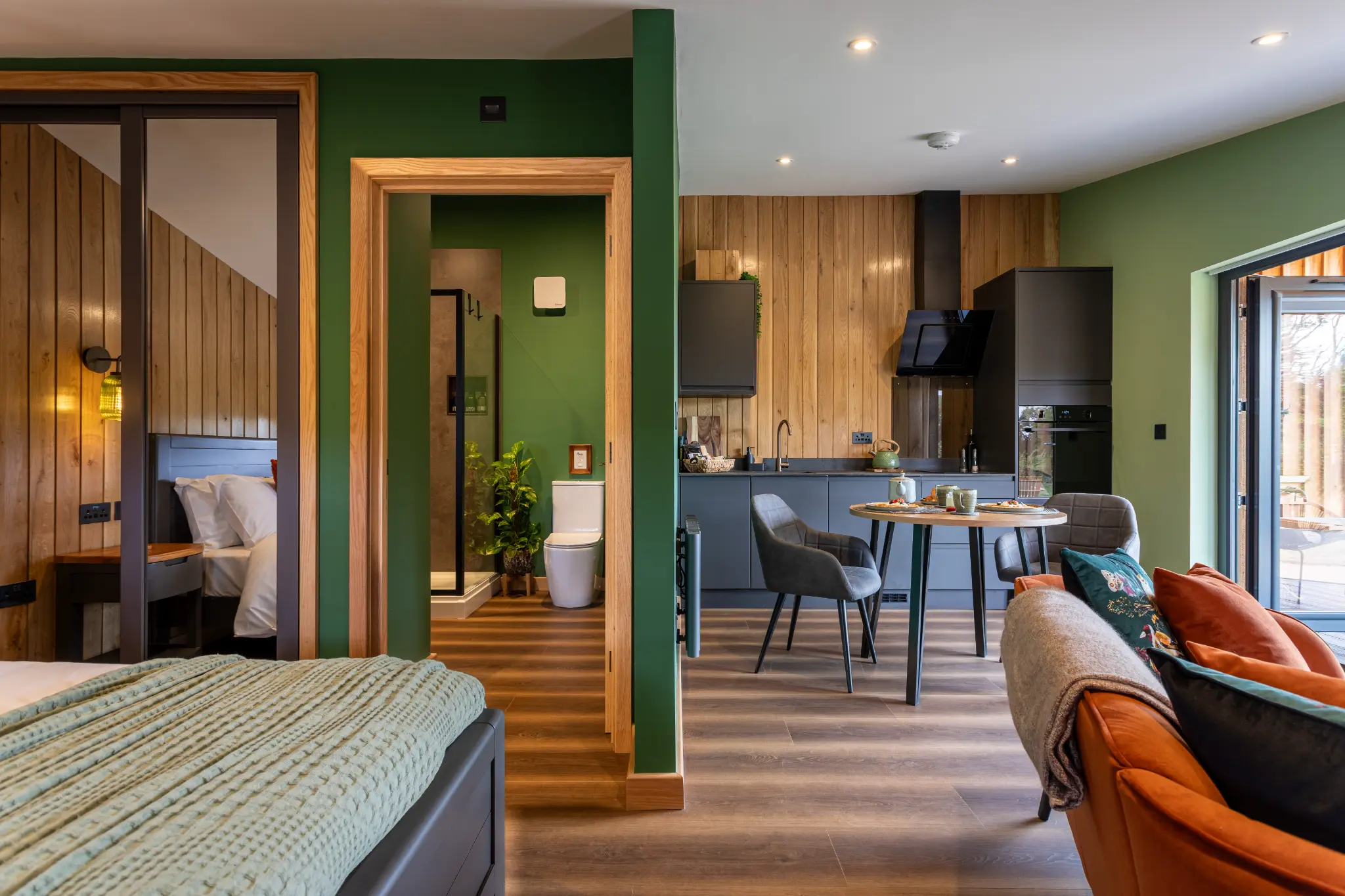
Shooting from the bed towards the kitchen shows the whole layout in one image. The deep green feature wall and the cedar panelling are the two materials that define the interior, and getting both in the same frame with the doors open behind is what makes the space feel considered rather than just small.
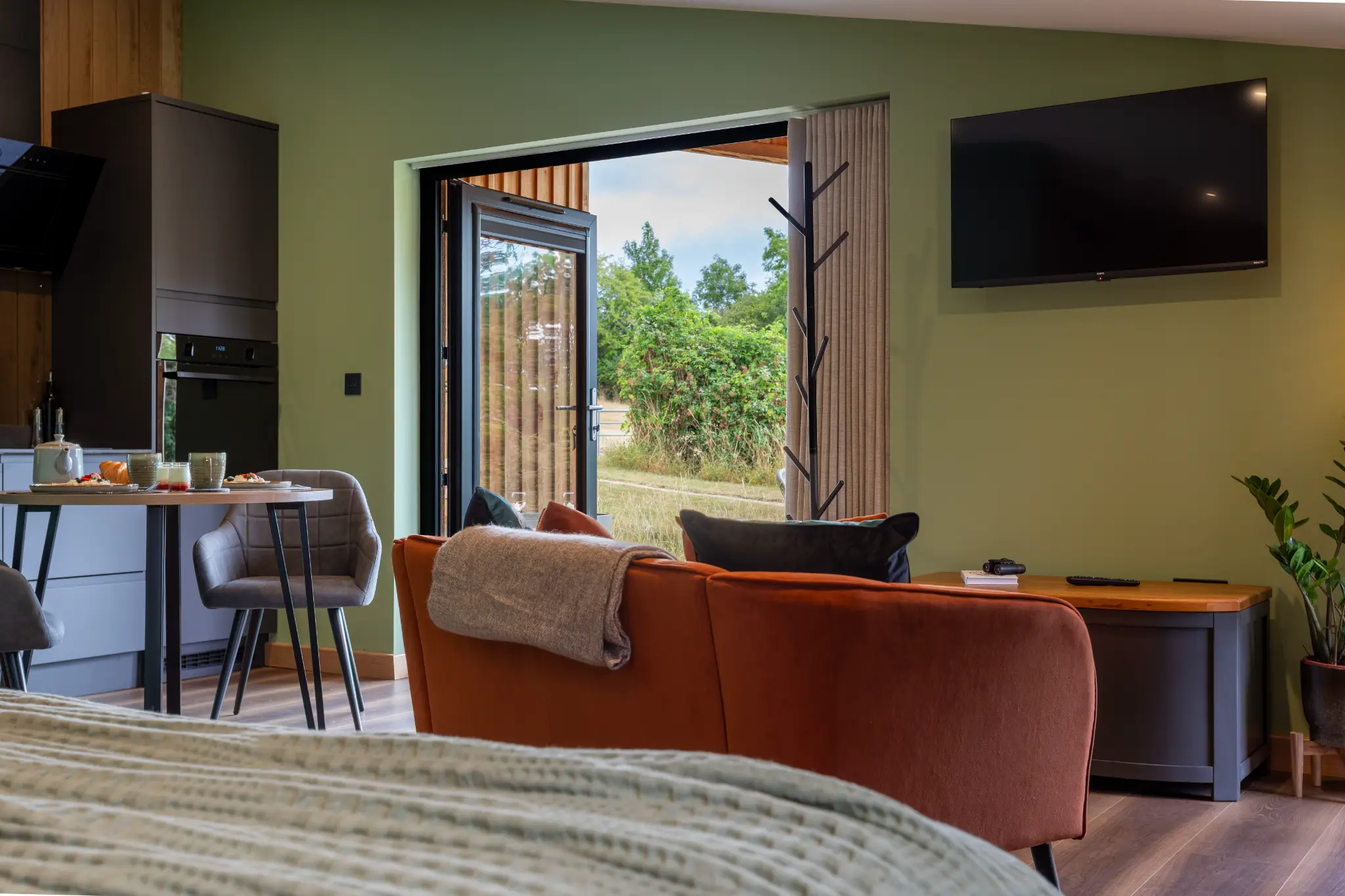
The living end, with the rust-toned sofa against the green wall. Colour is doing a lot of work in this cabin and it needed careful handling in the edit. Green walls reflect green light onto everything nearby, including bedding and skin tones, so the white balance was set per-frame rather than batch-applied across the set.
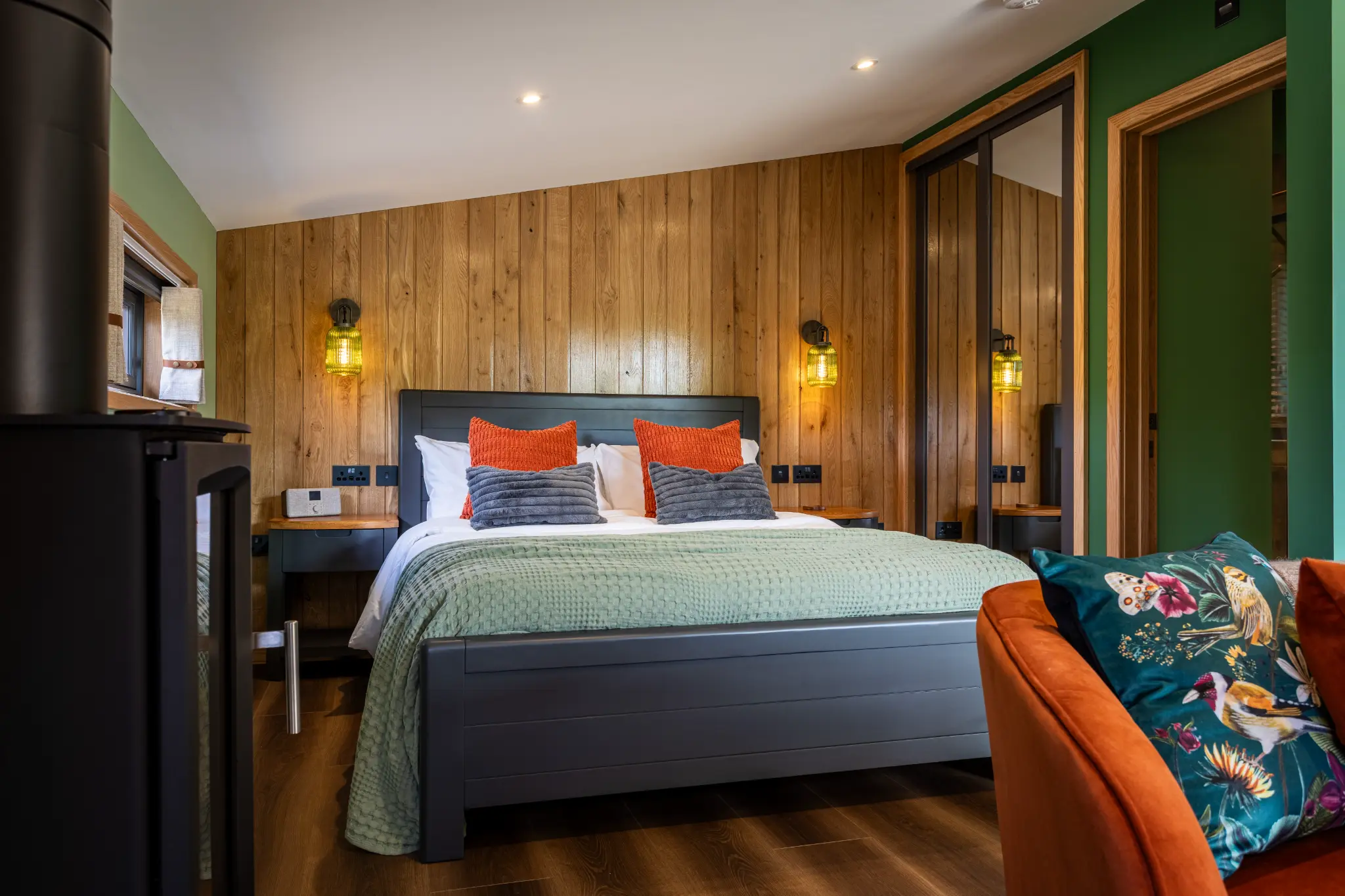
The bed with the wall lights on and the wood burner in frame. Turning the lamps on gives this frame a completely different mood to the daylight interiors, and for a romantic retreat the lamp-lit version is often the more persuasive image.
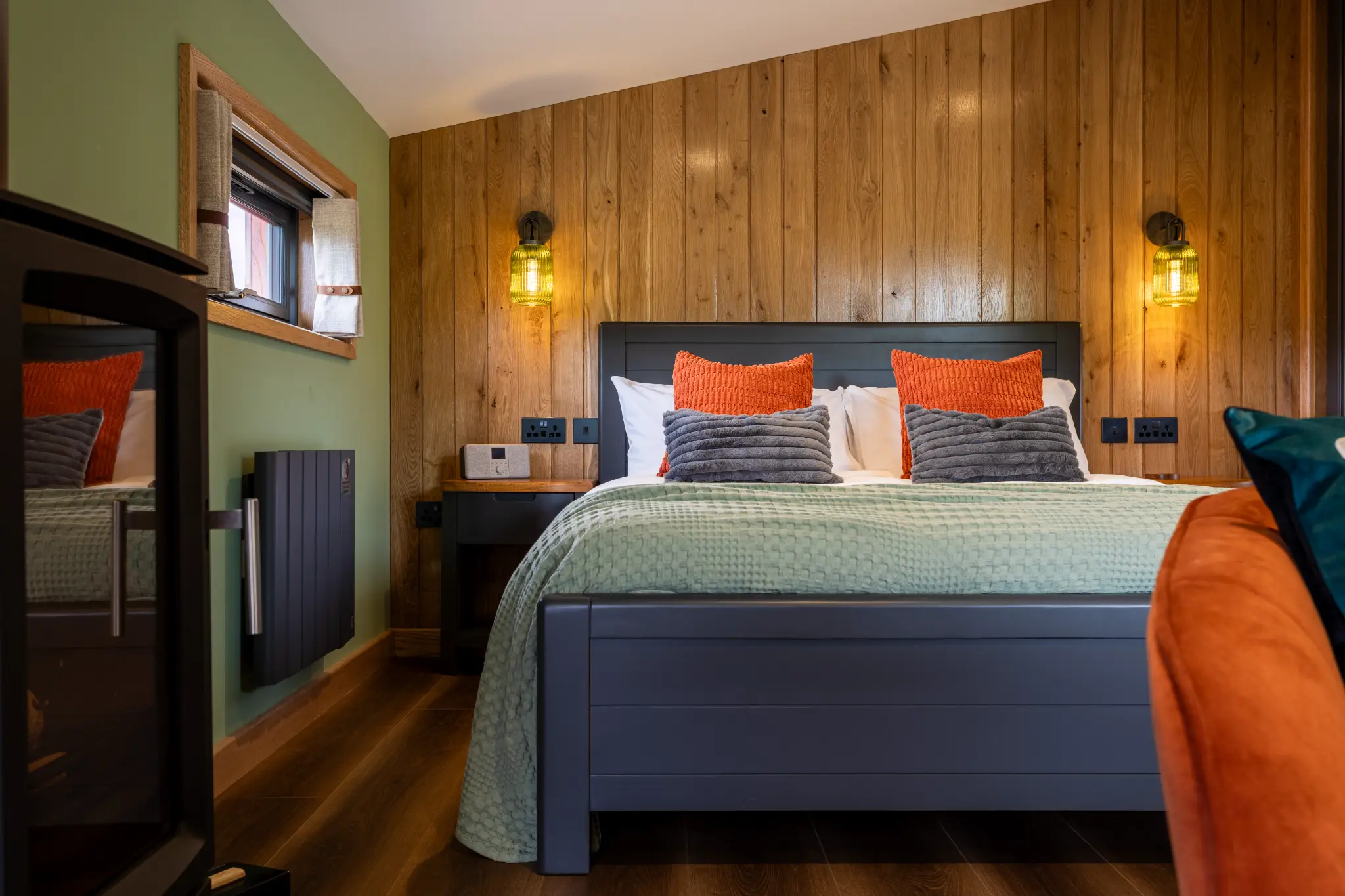
A straight-on frame of the bed. Every listing needs one honest, well-lit, undistorted photograph of the bed, because it is the thing being booked. Styling here was minimal, crisp bedding, the rust and grey cushions squared off, nothing fussy.
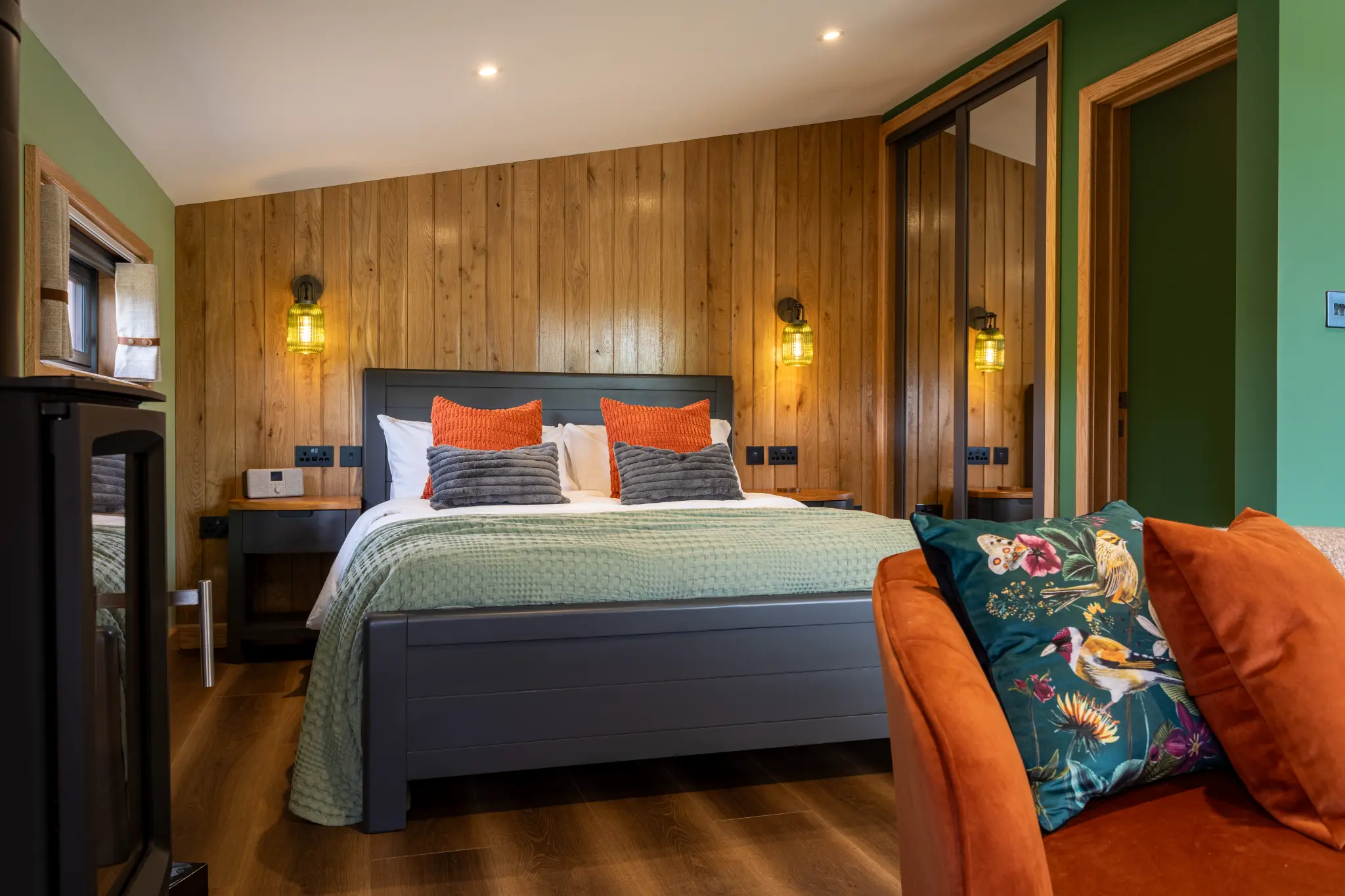
The same bed from an angle that includes the open en-suite door. Showing the relationship between the bed and the bathroom is more useful than it sounds, particularly in a compact property where a guest might reasonably wonder how the private facilities are arranged.
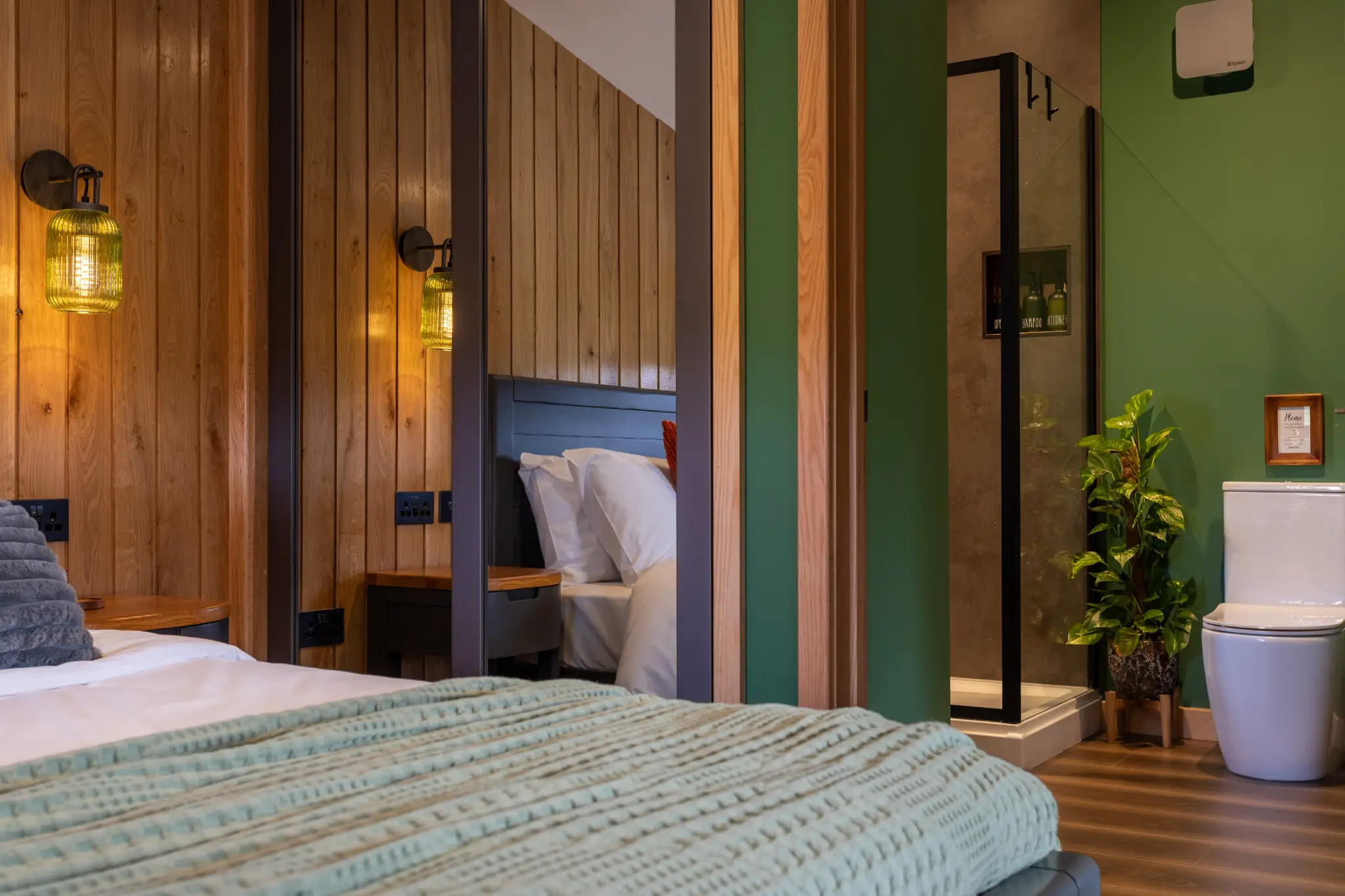
A layered composition with the bedding in the foreground and the en-suite beyond. Shooting through one space into another creates depth, which is exactly what a small interior needs, and it makes the cabin feel like it has more to explore.
06The Kitchen and Dining
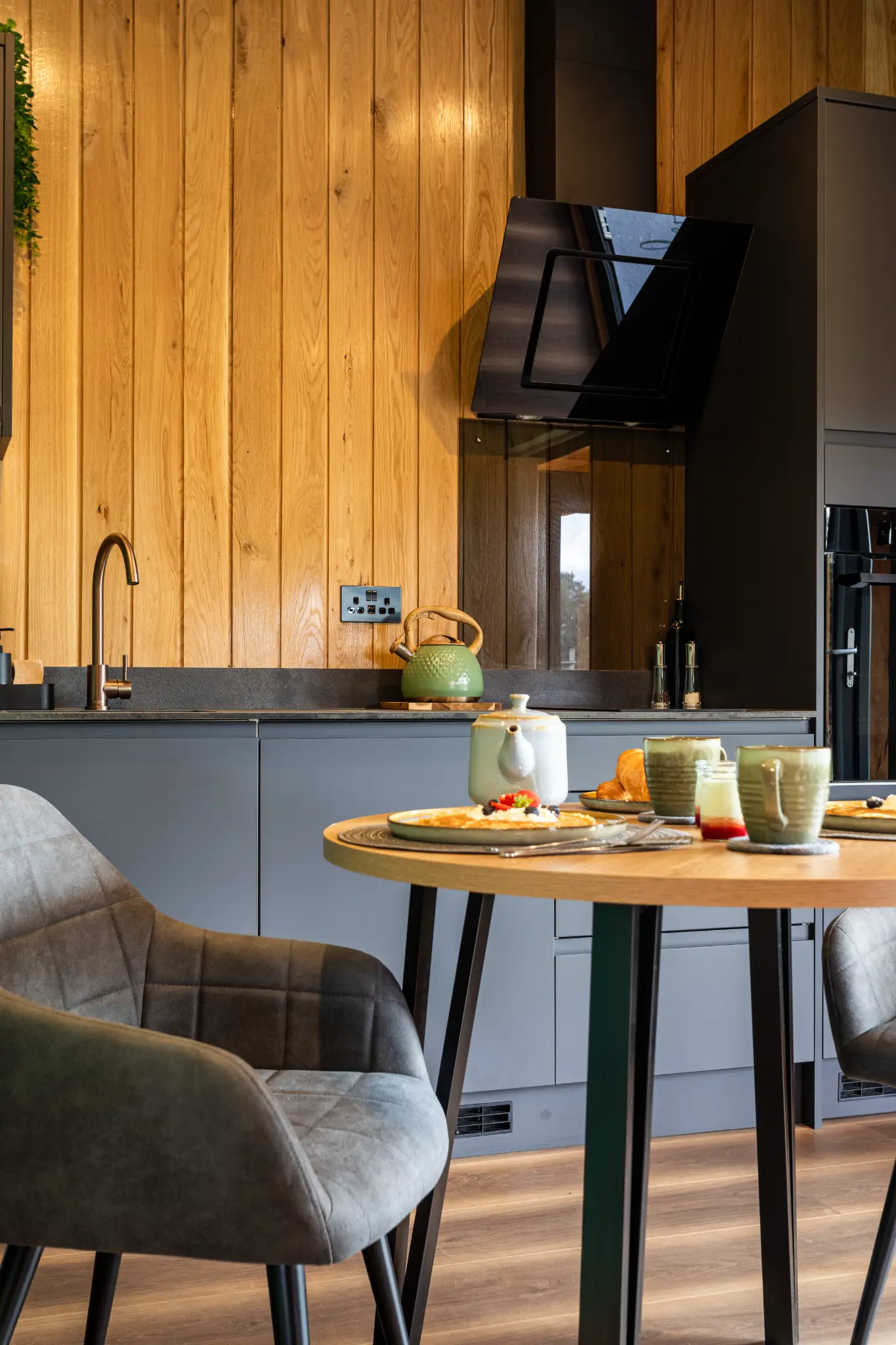
A table laid for two with candles lit. For an adults-only cabin this frame answers a specific question, whether you can actually have a proper dinner in, rather than eating off your knees. The kitchen is fully fitted with an induction hob, oven and dishwasher, and showing it in use is more convincing than showing it empty.
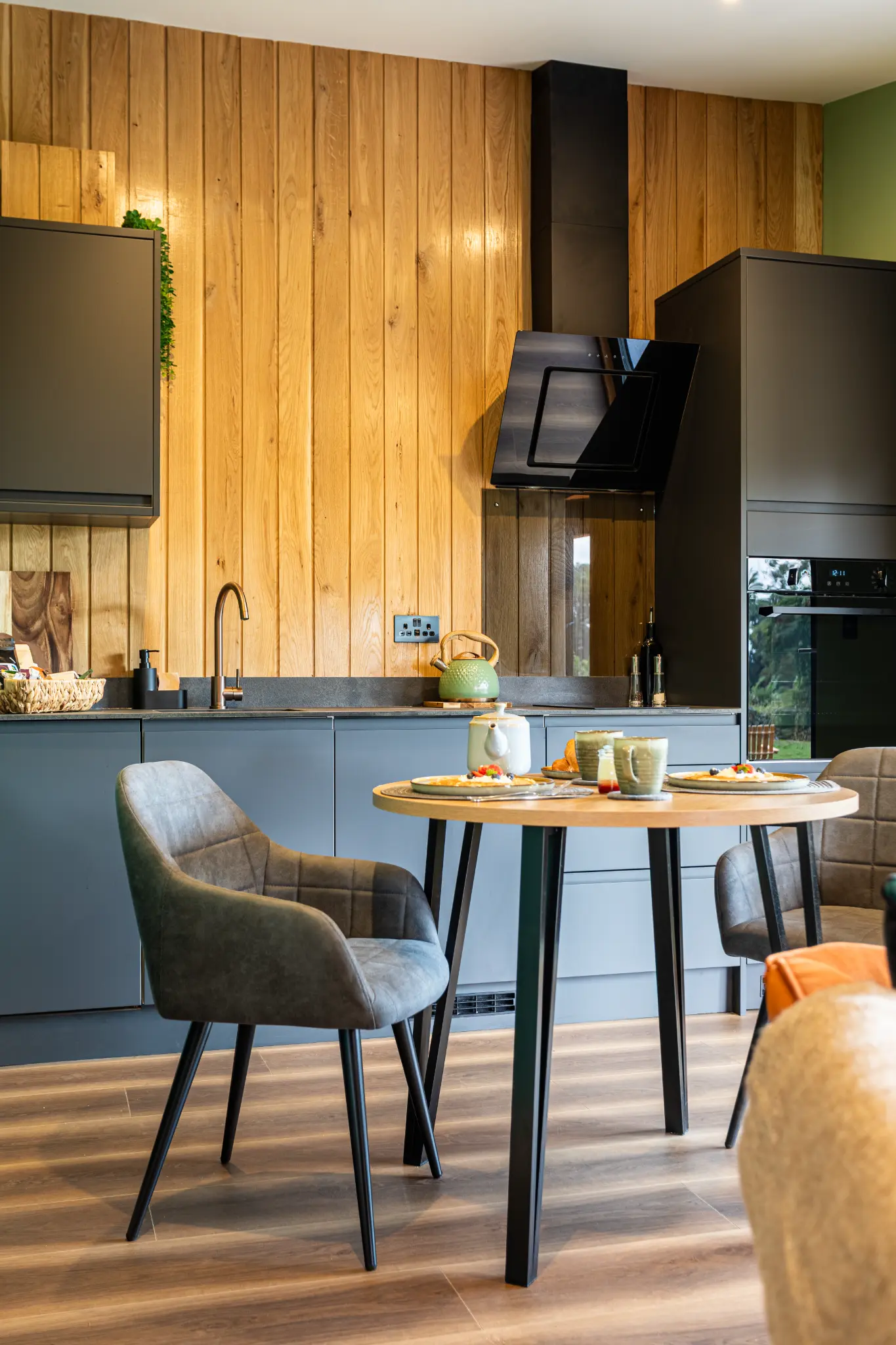
A portrait frame covering the kitchen run, the table, and the wood burner together. Compact kitchens in luxury lets are often under-photographed because owners assume they are not a selling point. They are, but only if the images show that the kitchen is properly equipped rather than a token kettle and a microwave.
07The En-Suite
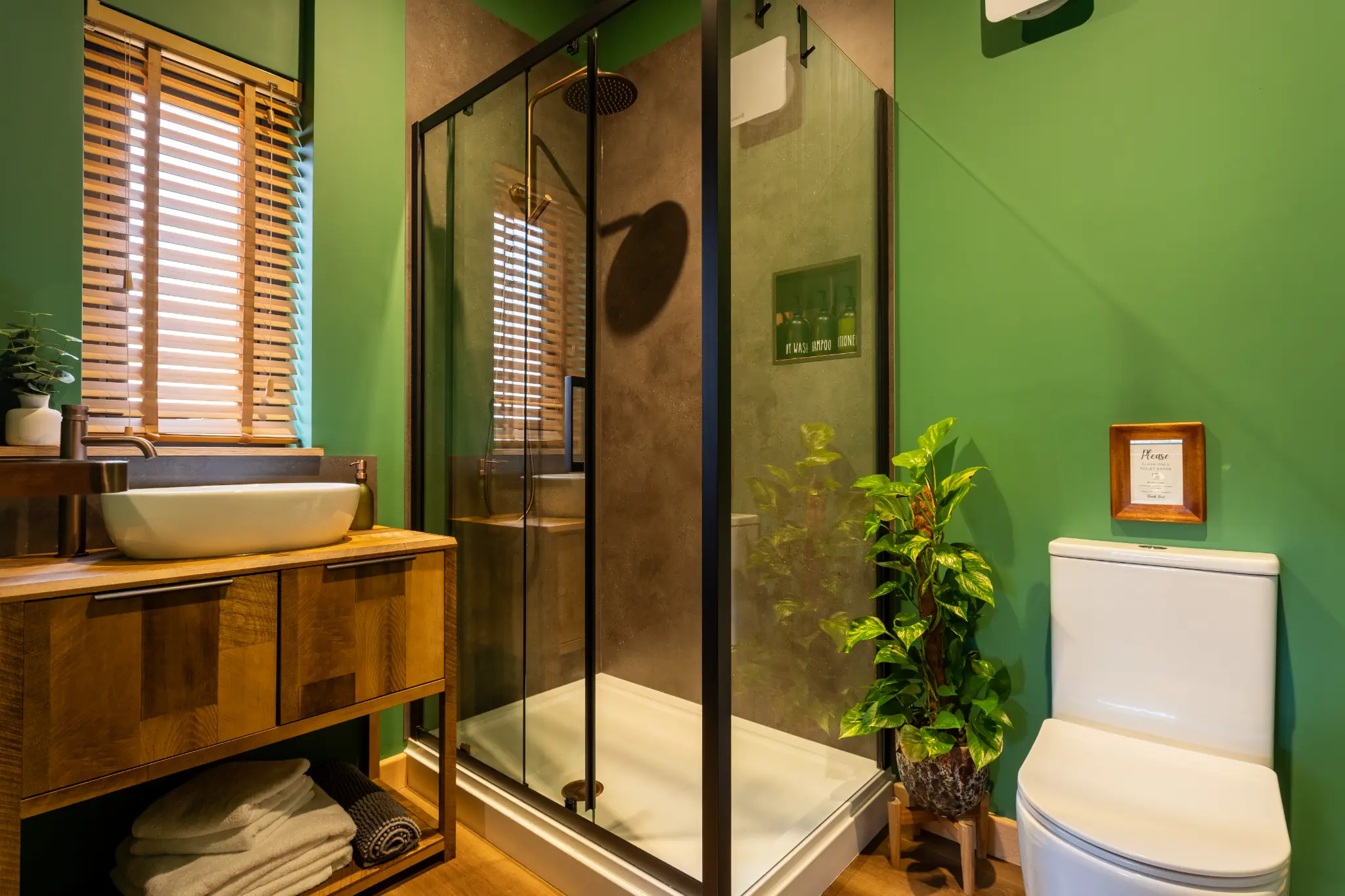
The shower room continues the green and timber palette, with a stone basin on a timber vanity and a large walk-in shower. Small wet rooms are among the hardest spaces to photograph well, because there is nowhere to stand, every surface reflects, and the mirror will show the camera if you are careless about position.
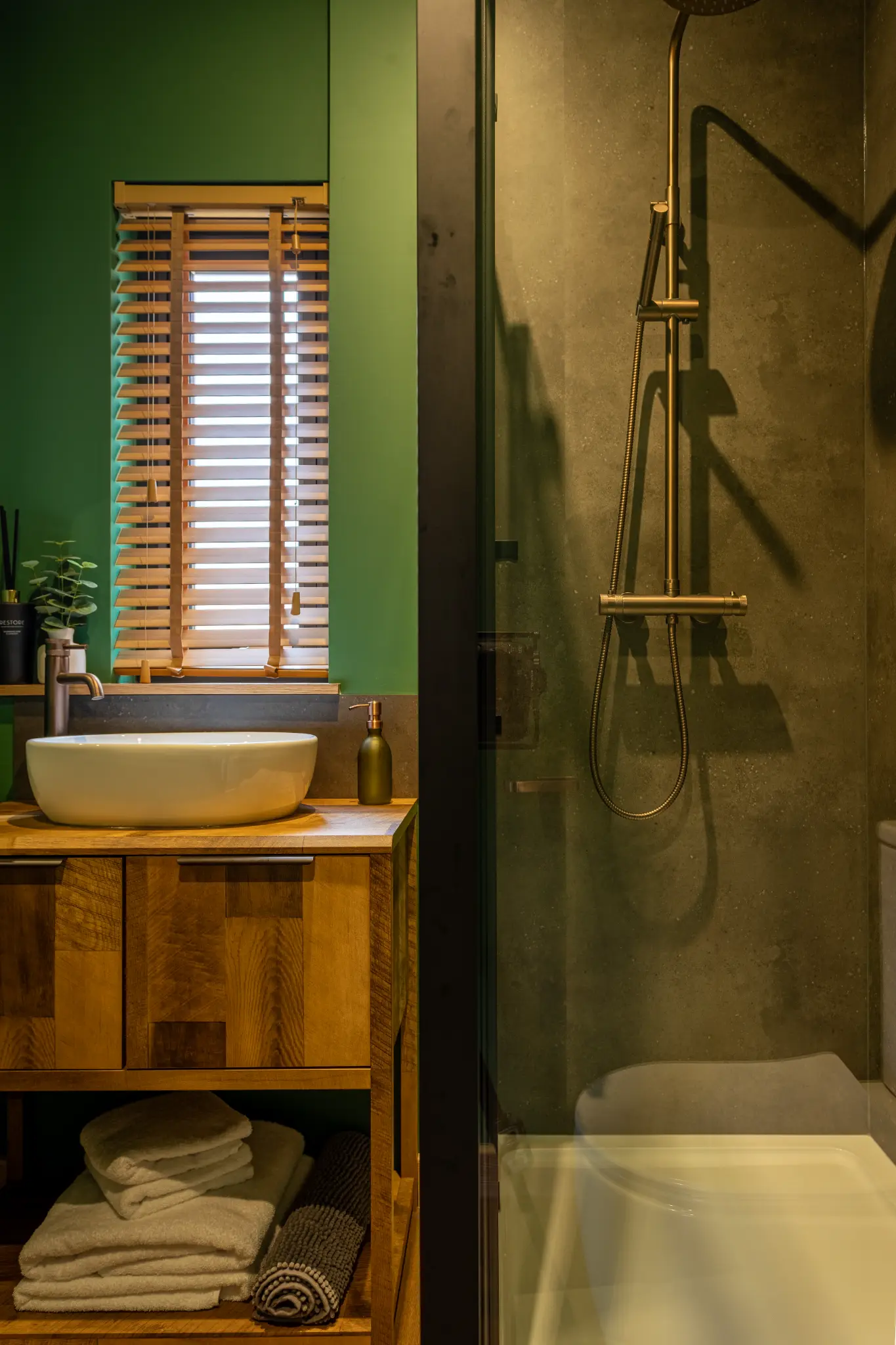
Portrait suits the proportions of this room far better than forcing a landscape crop. The towels and toiletries were placed rather than left as found, because a bathroom photograph with nothing in it reads as unfinished rather than clean.
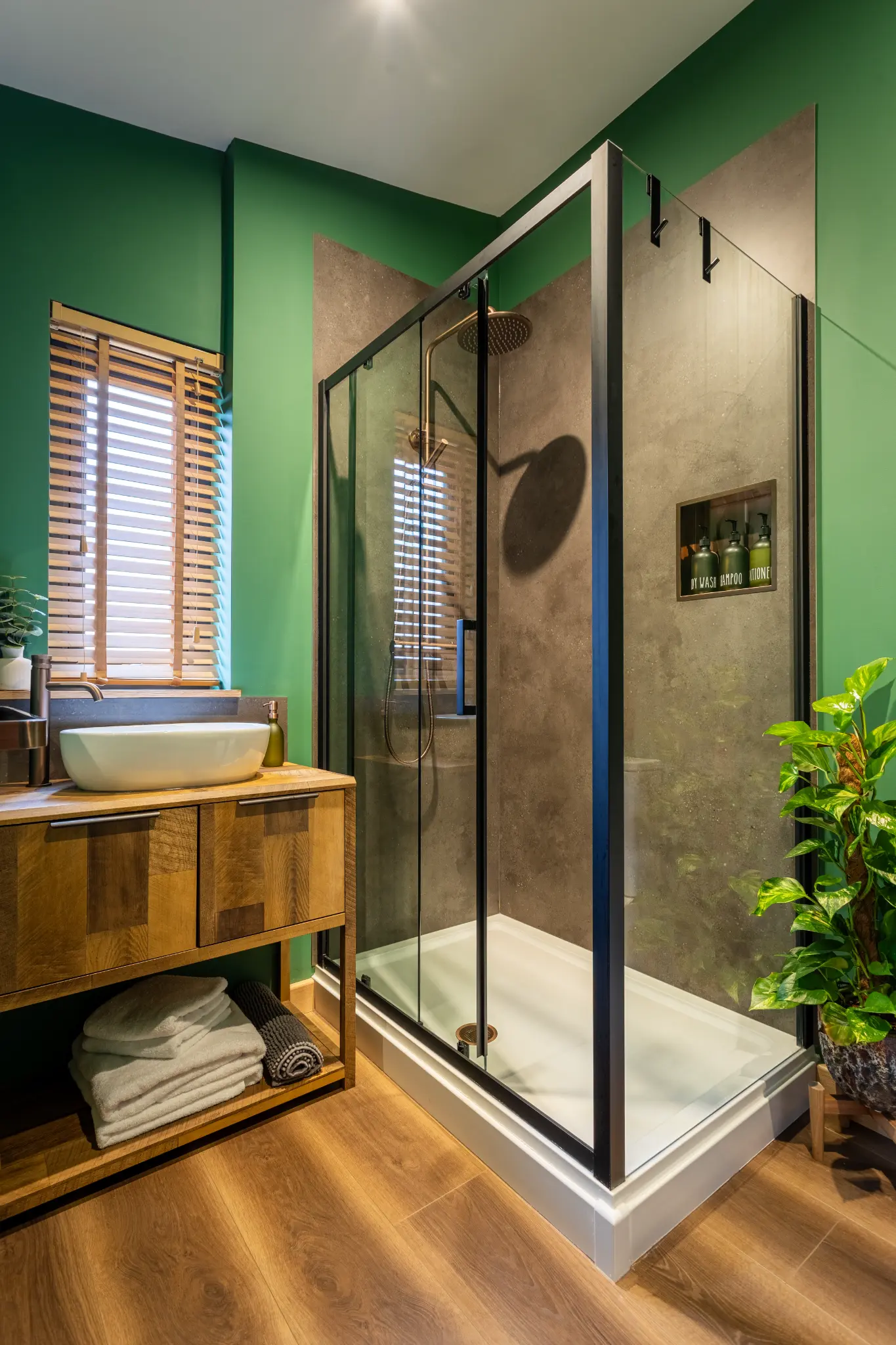
A second angle showing the shutters and the natural light. Daylight in a bathroom is a genuine luxury signal, and it is worth composing to make the window visible rather than shooting away from it.
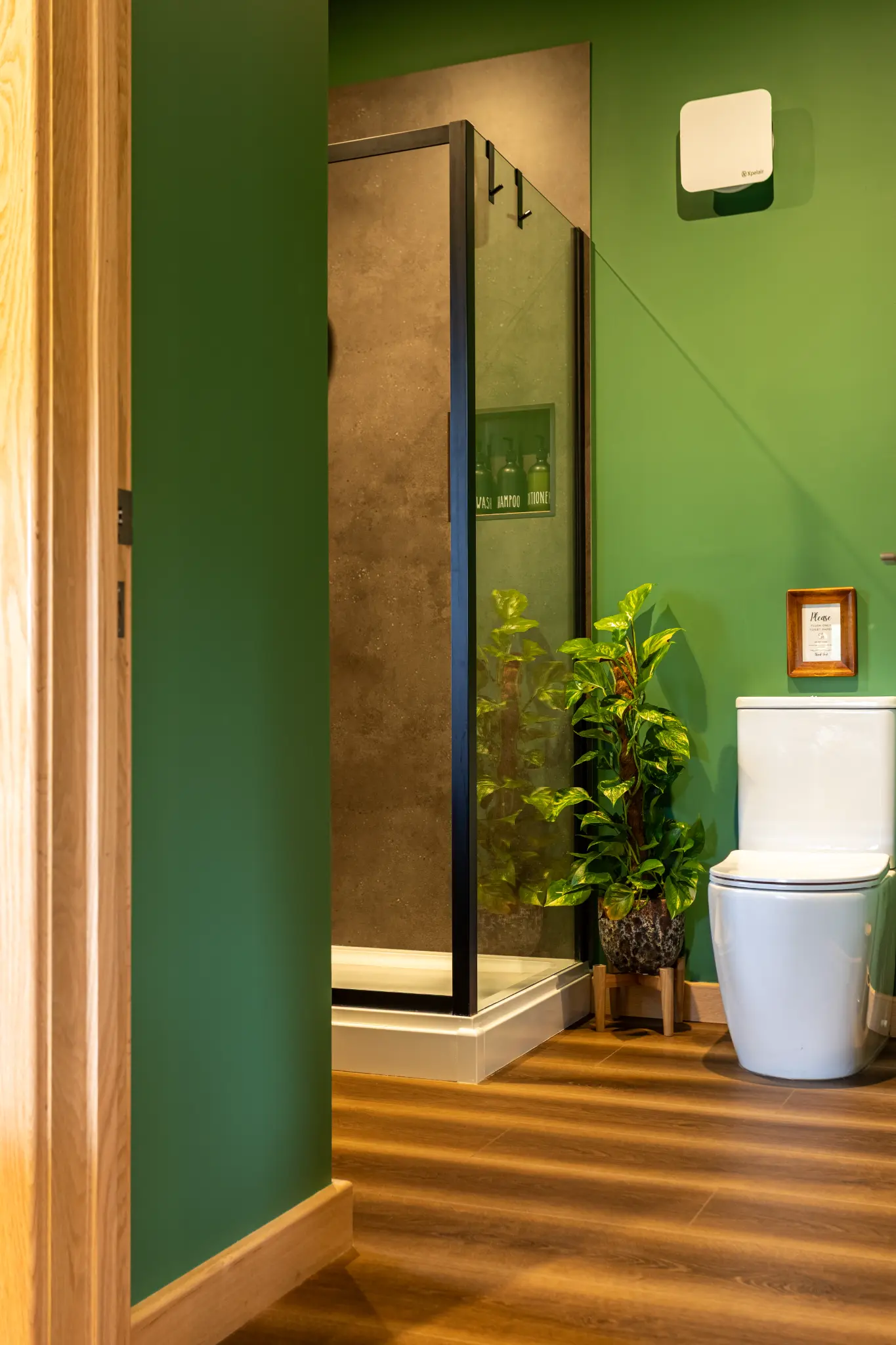
Framed through the doorway from the main room. As with the bedroom frames, this establishes how the spaces relate, and the door frame gives the composition a natural border.
08What Made This Set Work
Four decisions did most of the work on this shoot, and they transfer to any high-end rural let.
The shoot was a full daytime session. Interiors were photographed when the natural light through the open doors was at its strongest, and the exterior frames were processed in post to bring out the warmth in the cedar and the meadow grass. Cedar cladding and dry grass both respond well to tonal editing, and the atmospheric quality in the final set came from that processing rather than a particular time of day.
The doors were open in almost every interior frame. In a cabin this size, the countryside is the extra room. Closed doors make the interior a box, open doors borrow the entire meadow.
The hero feature was shot repeatedly and in both orientations. The outdoor bath appears in six frames from different distances and angles, because it is the single element most likely to convert a browser into a booking, and the owners need it in landscape for the listing, portrait for social, and tight for detail.
Styling was light but deliberate. A poured glass, a lit candle, a bath tray, a folded robe. Nothing that pretends the cabin is something it is not, but enough to show the property being used rather than presented.
09What the Owner Said
"We recently launched our first luxury self-catering cabin in the Forest of Dean and, after muddling through the first month using photos I'd taken myself, I realised it was time to invest in some professional photography for our website and marketing. I found Matthew through a Google search, and from my initial enquiry he was quick to respond and a pleasure to deal with. His communication throughout the whole process was excellent. Most importantly, the photographs are outstanding. Matthew has perfectly captured the luxury feel we wanted to portray, and the drone images showcase just how peaceful and secluded the cabin is within its surroundings. I couldn't be happier with the results and will definitely be inviting Matthew back to capture the changing seasons as the landscape around the site continues to develop. Thank you, Matthew!"
10Why This Matters for Luxury Let Owners
The commercial case for photographing a property like this properly is easier to make than for almost any other sector, because the numbers are visible. A cabin for two at a premium nightly rate lives or dies on its lead image, and the difference between a listing that converts at a decent rate and one that does not is often a single photograph.
There is also a rate argument. Guests do not pay a premium because a description says luxury, they pay it because the images look like the experience is worth it. Photography is the only part of the marketing that can demonstrate quality rather than assert it, and for a new property launching without reviews it is the only evidence available at all.
The other point specific to properties like Ochre Hill is that a strong set reduces dependence on listing platforms. Owners with genuinely good imagery can build a direct booking website, run social campaigns, and pitch to editorial and travel features. Ochre Hill has already been picked up by Coolstays, and that kind of coverage is driven almost entirely by whether the photographs are strong enough to feature.
If you are launching a lodge, cabin, or rural retreat, the ideal time to shoot is the week the styling is finished and before the first guests arrive. That window, when everything is complete and nothing is worn, does not come round again.
11Ready to Photograph Your Lodge or Retreat?
If you own or are launching a luxury lodge, cabin, or countryside retreat, get in touch for a free quote. I photograph holiday lets and short-stay properties across Gloucestershire, the Forest of Dean, the Cotswolds, Somerset and Bristol, with drone coverage included where the setting justifies it, and I travel UK-wide for rural retreats where the landscape is part of the product.
Related: Airbnb & holiday let photography | Holiday let photography | Drone photography | A-frame eco lodge, Herefordshire