How to Run a Virtual Open Day for Your School or College
A practical guide to structuring a virtual open day: the welcome, the self-guided tour, live Q&A slots and the follow-up. Plus how it earns its keep in clearing and international recruitment.
Loading...
Tour Formats
By Location
By Sector
Virtual Tours
Matterport 3D scanning, bespoke 360° tours, and Google Street View — for residential, commercial, hospitality, and heritage clients. UK-wide coverage, overseas on request.

Campus tours built for admissions, open days and staff recruitment. Real projects at Cambridge college, independent school and further education level, across the UK.
I photograph and build virtual tours for educational institutions across the UK, from primary schools through to Cambridge colleges. The work sits alongside the rest of my UK-wide virtual tour services, but education is different enough from commercial property to deserve its own explanation, because the brief is rarely just "show the building".
An admissions tour has to do several jobs at once. It has to help a family decide whether to spend a Saturday visiting you. It has to answer the practical questions that otherwise arrive as emails to your registrar. It has to work for the applicant who lives four thousand miles away and will never attend an open day. And increasingly it has to help you recruit staff, because a candidate deciding whether to move counties for a post wants to see where they would be working.
What that means in practice is that the structure of the tour matters more than the individual panoramas. A tour that drops a visitor into a corridor with no sense of where they are is worse than no tour. The ones that work follow the route a real visit would take, carry the information a real visit would give you, and end somewhere useful, usually an open day booking form.
I shoot in all three tour formats, so the recommendation you get depends on your site, your budget and who will maintain the tour afterwards, rather than on which camera I happen to own. Below are seven education tours I have produced, then the platform features worth knowing about, then honest pricing.
Four types of institution, with genuinely different reasons for wanting a tour.
Admissions is the main driver. A tour lets a family in another county, or another country, understand the school before committing to a visit, and it gives the families who do visit a way to revisit what they saw when they are making a decision weeks later. It also does quiet work you may not have planned for: reassuring a nervous child about where the toilets and the dining hall are before their first day.
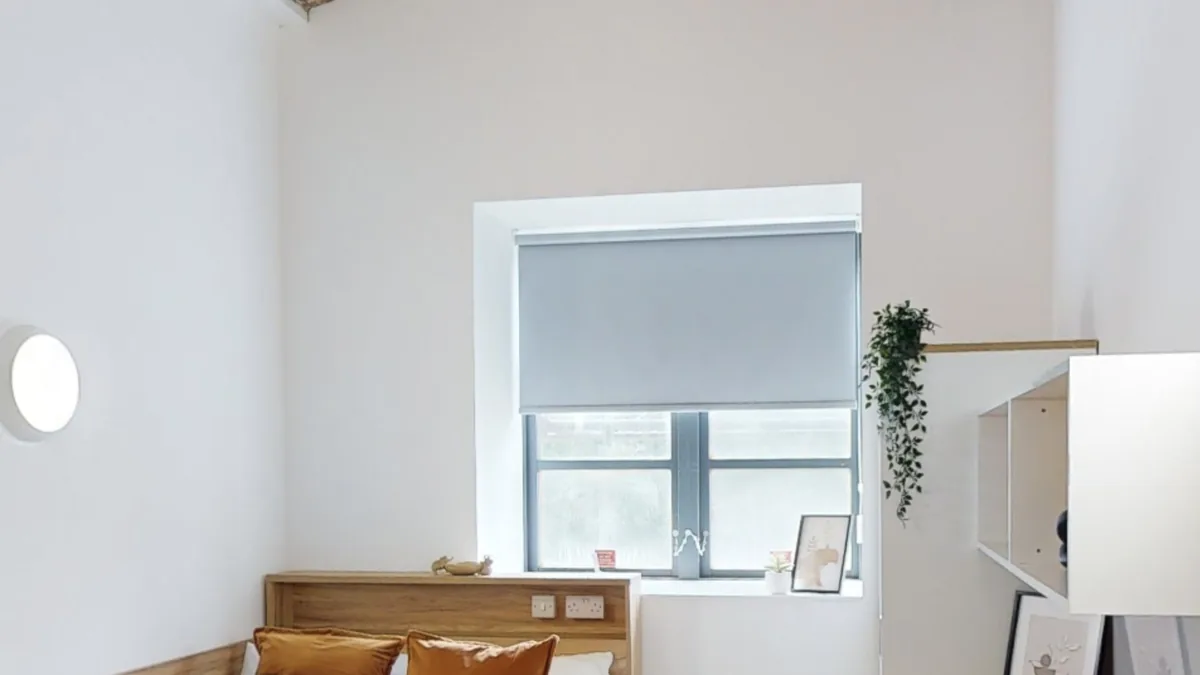
Open days cannot scale indefinitely and not every applicant can travel. A tour covering accommodation, teaching spaces, libraries and the students' union answers the questions applicants actually ask, and it works just as hard for international applicants who will never attend an in-person open day. It also serves staff recruitment, which is often the use nobody anticipated at the briefing.
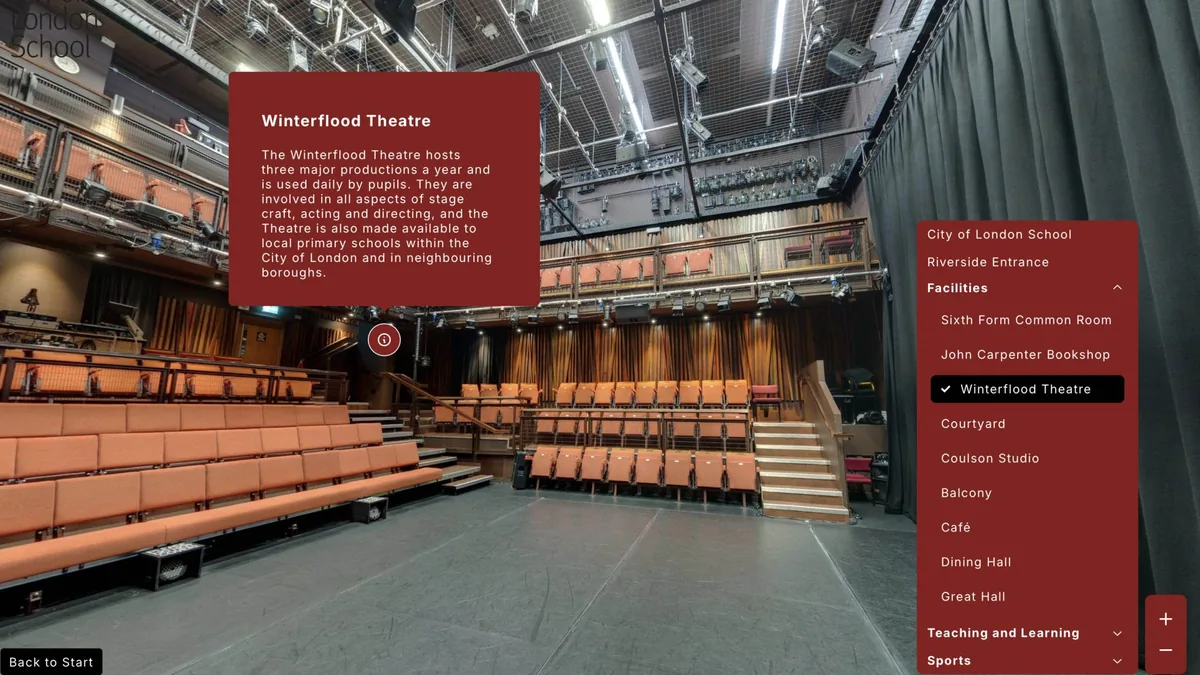
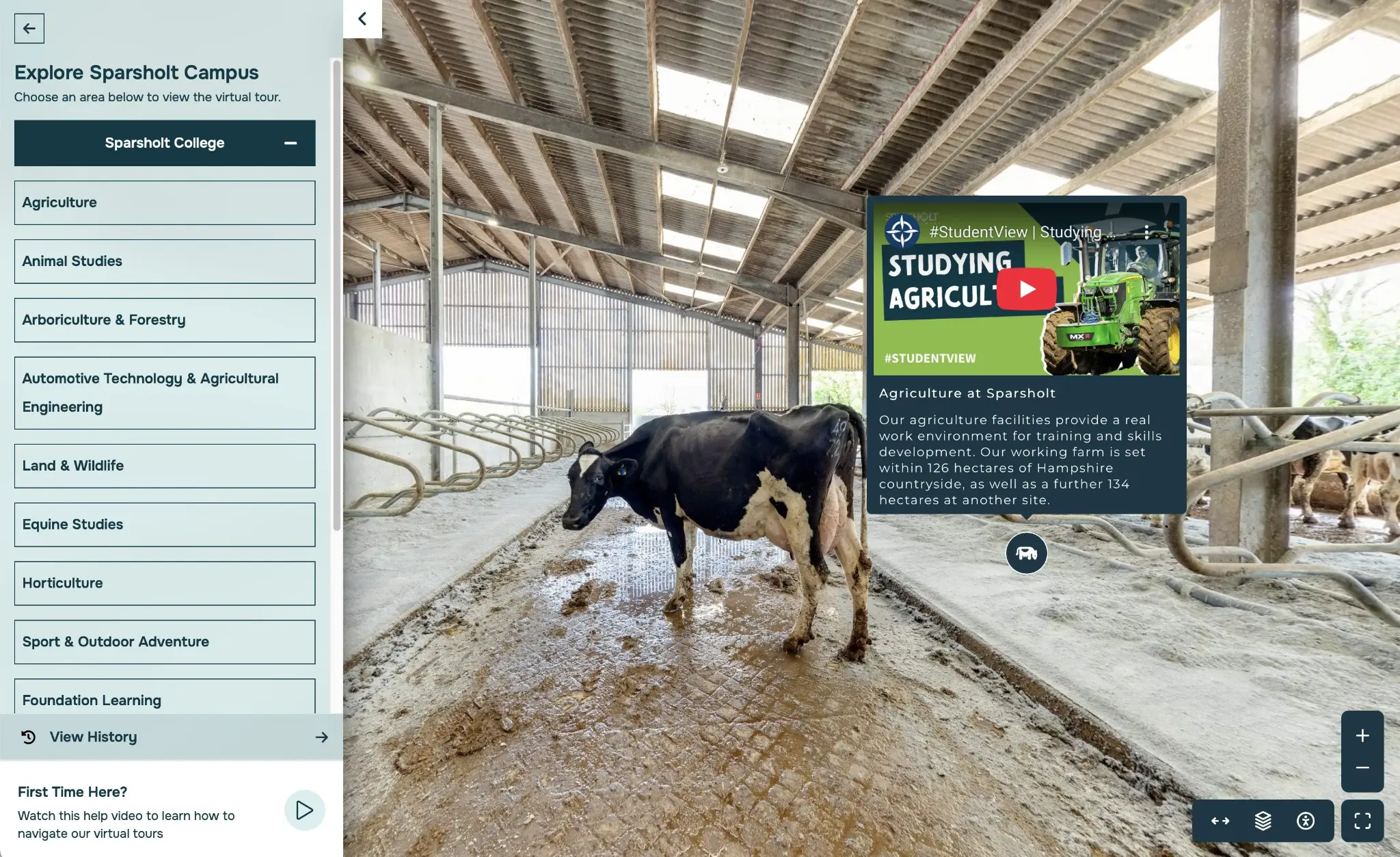
Specialist facilities are the selling point and they are exactly what a prospectus struggles to convey. Workshops, laboratories, salons, equine yards and farm units read very differently in a tour than in a photograph, because the visitor can see the scale and the equipment rather than a composed frame of it.
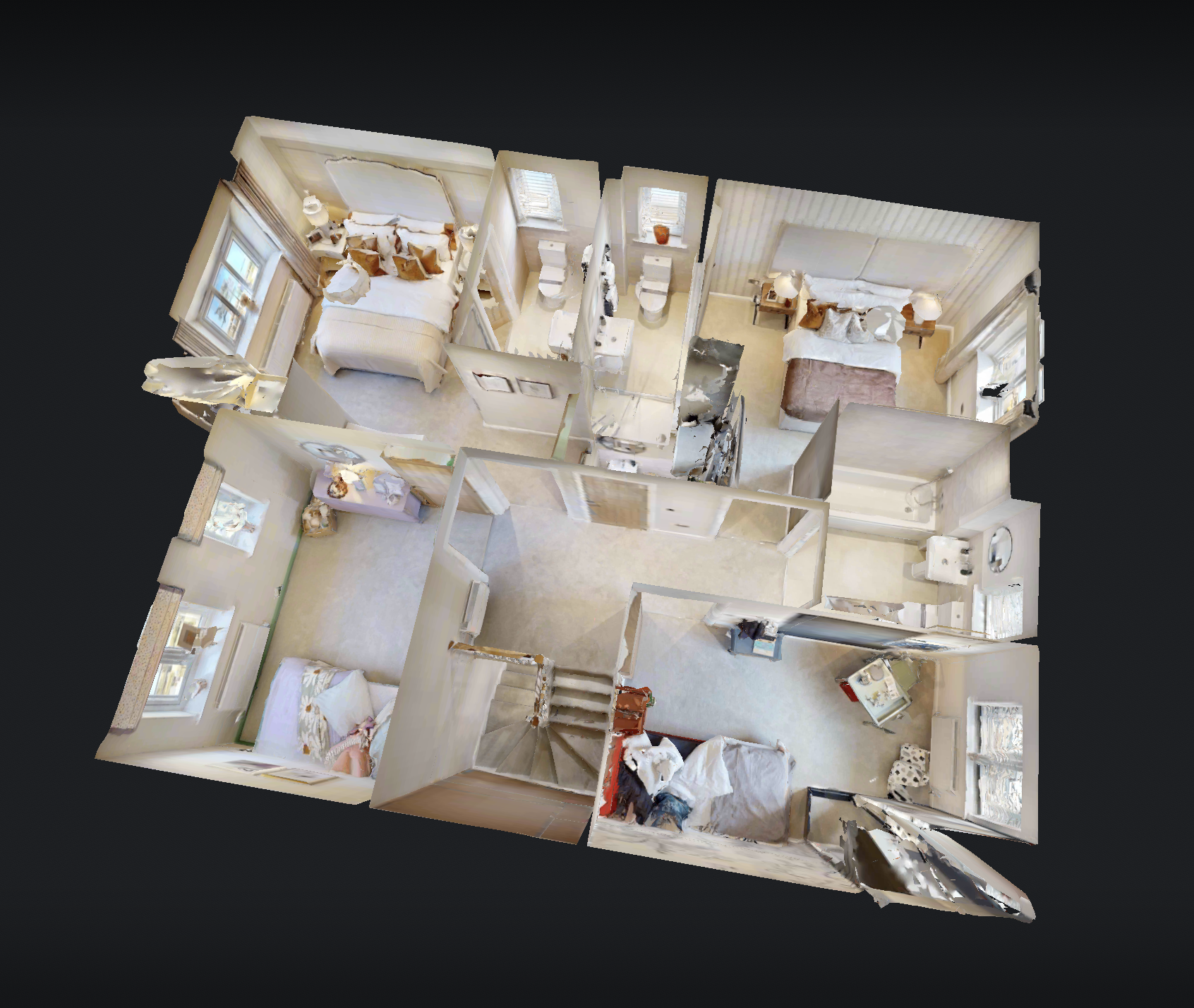
Boarding houses carry the most anxiety for families and get the least coverage in most school marketing. A tour of the houses, the common rooms and the dormitories does more to settle a parent than any amount of copy about pastoral care.
Student accommodation providers sit slightly outside this list but commission similar work. If that is your sector, my student accommodation photography page is the better starting point.
Explore the Sidney Sussex College tour below, then see six more education projects underneath.
Loading virtual tour...
Sidney Sussex College, Cambridge — A thirty location tour of the college, built with interactive hotspots, aerial establishing scenes, video highlights and call to action buttons throughout. Prospective students can move from the porters' lodge through courts, accommodation and dining hall in the order they would on a real visit.
Not every tour needs every one of these. Which apply depends on your site and who will look after the tour once it is live.
Tours built on the studio platform come with a content management system. When a new building opens, a department moves or a photograph goes out of date, your marketing or admissions team can change it without coming back to me. Several departments can work on the same tour, and an existing tour can be duplicated as the starting point for next year's version.
Any point in the tour can carry more than a panorama. Text panels, image galleries, embedded video and links out to your prospectus or application form all sit inside the tour, so a visitor who wants detail on the sixth form curriculum can get it without leaving the scene they are looking at.
A primary school and a multi-campus university need very different things from a tour. The interface, navigation and styling are built to match your brand and the way your institution actually presents itself, rather than dropping your logo into a generic template.
Tours are navigable by keyboard as well as mouse, work with screen readers, and include a widget for adjusting font size and letter spacing. For a publicly funded institution in particular, this matters as much as how the tour looks.
Buttons fixed to the interface follow the visitor through the tour, so booking an open day or starting an application is always one click away rather than something they have to go hunting for once they have finished looking round.
Some campuses are best entered through an illustrated map, some through an aerial scene, and some straight into reception. Which one works depends on how spread out the site is and how familiar visitors are likely to be with it.
From shoot to published tour is typically one to two weeks, which means a tour commissioned early in a term can be promoting your open day within the same term.
I have photographed working schools during term time with students and staff present, and I have shot empty sites during the holidays. Both work. Which is right depends on your safeguarding position and whether you want the tour to feel populated or to show the estate clearly.
Campus-wide projects are quoted on the number of locations and the time the site needs. These are the starting points.
From £249
Hosting £99/year after year one
From £449
No hosting fees, you own it outright
From £269
No hosting fees
Most of the education tours above are bespoke 360 projects, because campuses are rarely one building and schools usually want to own the finished tour rather than pay a platform fee indefinitely. If you are weighing the formats up, the format comparison sets out the trade-offs. for a quote against your site.
Ready to get your property looking its best? Drop me a message and I'll get back to you within a few hours to confirm availability and sort out a time that works for you.
Professional photography that helps your property stand out. Fixed prices, no hidden fees, no fuss.