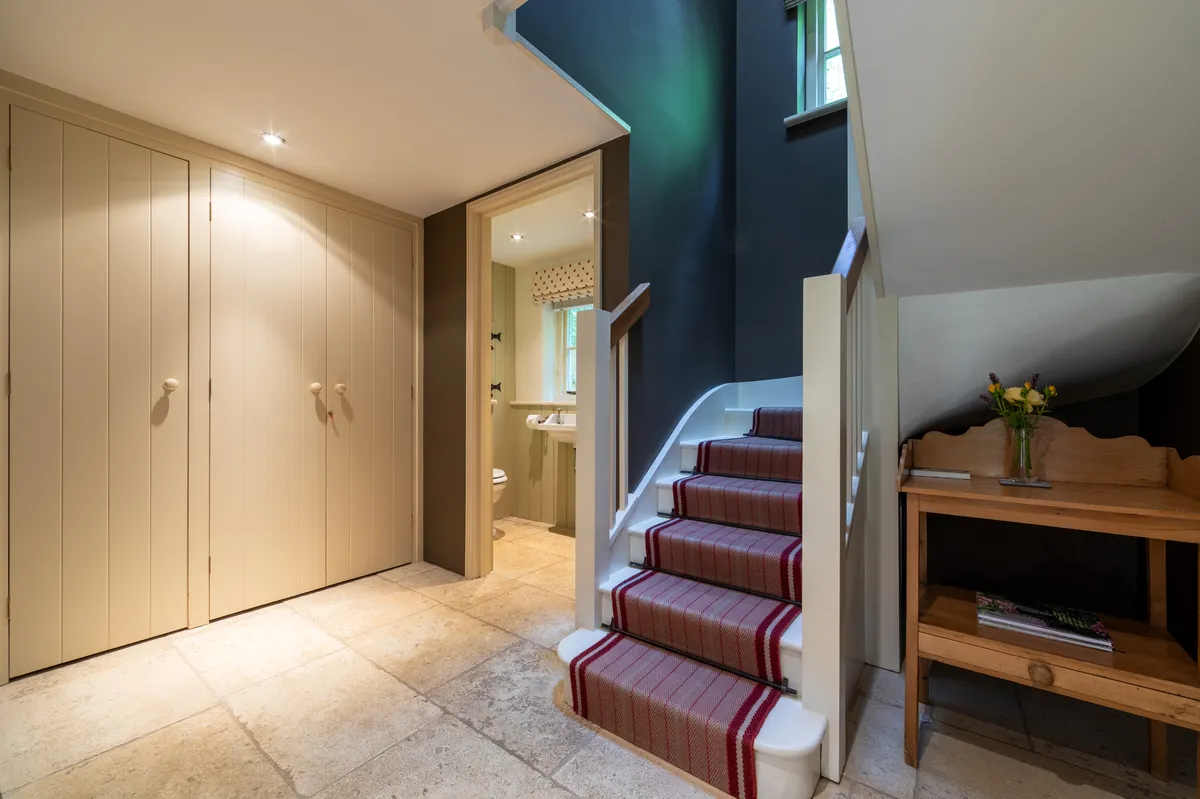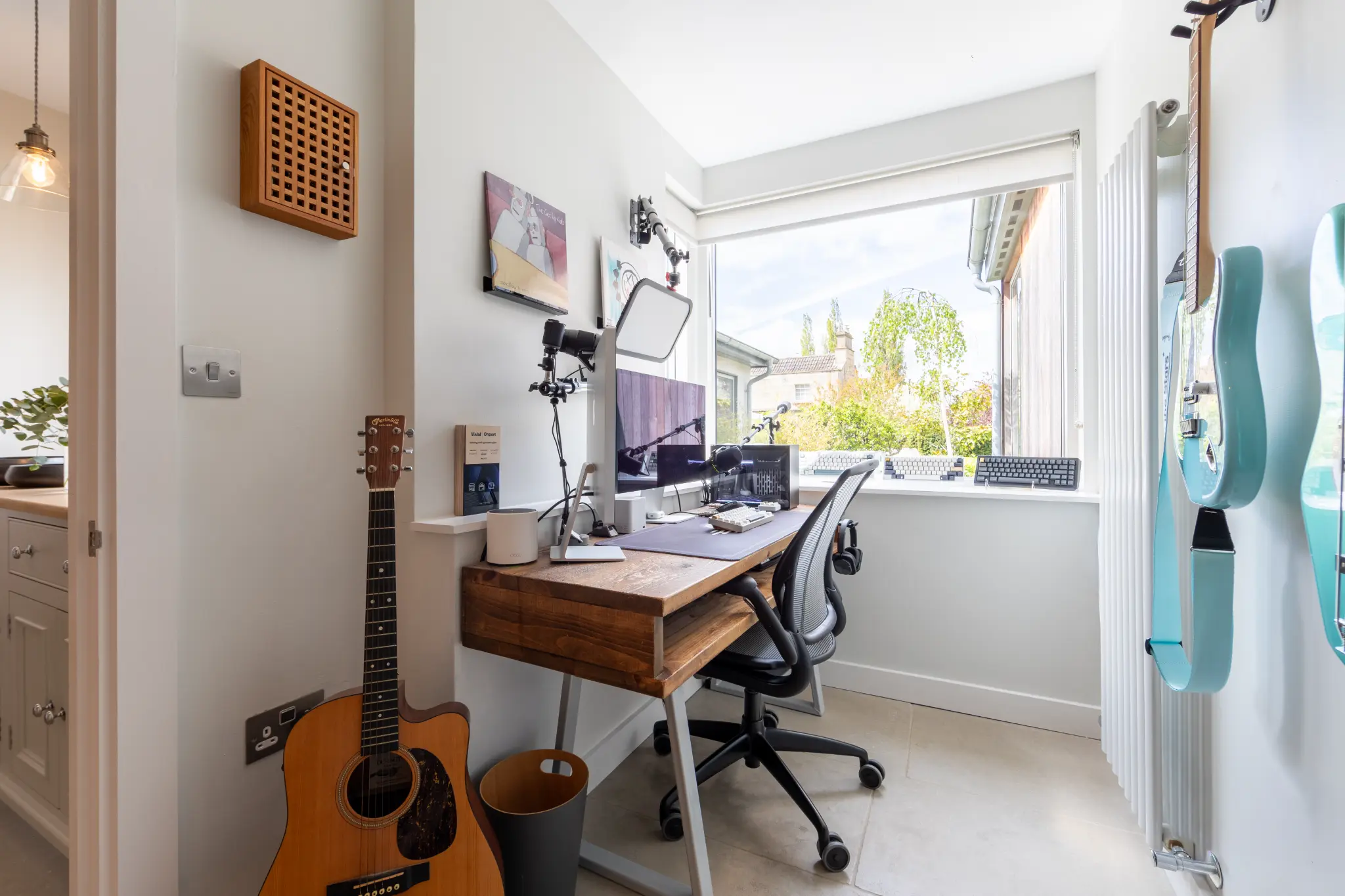

With 40% of UK workers now working from home at least part-time, a dedicated home office is the 4th most-searched property feature on Rightmove. Properties with a well-photographed workspace sell 12% faster according to Zoopla. Key tips: position the desk near natural light, clear all cables and clutter, show the full room dimensions, and photograph the video call background. The Property Photo Guy includes home office photography in all standard packages from £175.
The way we work has changed permanently. Since 2020, the proportion of UK workers spending at least part of their week working from home has settled at around 40%, according to the Office for National Statistics. And this shift has fundamentally changed what buyers and renters look for in a property.
A dedicated home office or workspace is no longer a nice-to-have, it's a deal-breaker for millions of property searchers. Rightmove reported that searches for "home office" increased by 126% between 2019 and 2024, and the trend shows no sign of reversing. For estate agents, landlords, and homeowners selling or letting a property, this means one thing: if your property has a workspace, it needs to be photographed properly. And if it doesn't, you need to think creatively about how to show the potential.
01The Data: Why Home Office Photos Drive Enquiries
The numbers are compelling:
| Statistic | Source |
|---|---|
| 40% of UK workers now work from home at least part-time | ONS, 2025 |
| "Home office" searches on Rightmove up 126% since 2019 | Rightmove, 2024 |
| Properties with a dedicated office sell 12% faster | Zoopla, 2024 |
| 67% of remote workers say workspace quality affects their property choice | CIPD, 2025 |
| Home office is now the 4th most-searched feature after garden, parking, and garage | Rightmove, 2025 |
What this means in practice is that a well-photographed home office can be the single image that converts a browser into a viewer. It's the room that makes a remote-working buyer think "I could work here", and that's a powerful emotional trigger.
02What Makes a Great Home Office Photo
1. Natural Light is Everything
The number one thing remote workers want in a home office is natural light. Position the desk near the window and photograph it with the light falling across the workspace. The image should feel bright, airy, and energising, not the dark, cramped box room that many people associate with working from home.
I use HDR photography to ensure the room is properly exposed while still showing the view through the window. This is particularly important for home offices, where the contrast between a bright window and a darker room can be extreme.
2. Show the Full Room, Not Just the Desk
A common mistake is photographing just the desk and chair. Buyers want to see the whole room, the dimensions, the storage, the door position, the window. I shoot home offices with the same wide-angle approach I use for bedrooms, showing the complete space so viewers can mentally place their own setup.
3. Cable Management and Clutter
Nothing kills a home office photo faster than a tangle of cables, a pile of paperwork, or a cluttered desk. Before the shoot: - Hide all cables behind the desk or use cable management clips - Clear the desk of everything except a laptop, monitor, and perhaps a plant or desk lamp - Remove any personal items, sticky notes, and paperwork - Tidy bookshelves, remove anything that looks cluttered or personal
4. The Video Call Background
Here's a detail that most photographers miss: show what the video call background looks like. Position the camera roughly where a webcam would sit and photograph the wall behind the desk chair. If it's a clean, professional-looking background, a bookshelf, a piece of art, a plain painted wall, that's a genuine selling point for remote workers who spend hours on Zoom and Teams.
5. Connectivity Signals
While you can't photograph Wi-Fi speed, you can photograph the infrastructure that suggests good connectivity. If the property has an ethernet port in the office, a mesh Wi-Fi system, or fibre broadband, these are worth mentioning in the listing and showing in the photos where possible.
03Types of Home Office Spaces and How to Photograph Them
The Dedicated Room
This is the gold standard, a separate room with a door that closes, used exclusively as an office. Photograph it as you would any other room: wide-angle shot showing the full space, plus detail shots of any premium features (built-in shelving, good natural light, a pleasant outlook).
Staging tip: A clean desk with a monitor, a quality desk chair, and a small plant creates the perfect "I could work here" image. Avoid staging with papers, coffee cups, or personal items.
The Converted Bedroom
Many properties have a spare bedroom that doubles as an office. The key is to photograph it primarily as an office (since that's the in-demand feature) while also showing that it could revert to a bedroom if needed.
Staging tip: If the room currently has a bed and a desk, consider temporarily removing the bed for the photoshoot to show the room's full potential as a dedicated workspace. Alternatively, photograph it from an angle that emphasises the desk area.
The Garden Office
Garden offices and studio pods have exploded in popularity. If the property has one, it deserves multiple photos: - An exterior shot showing the building in the garden context - An interior shot showing the workspace setup - A drone shot showing the garden office's relationship to the main house
Staging tip: Garden offices photograph best with the door open, showing the transition between indoor and outdoor space. A cup of coffee on the desk and an open laptop suggest a lifestyle that many buyers aspire to.
The Nook or Alcove
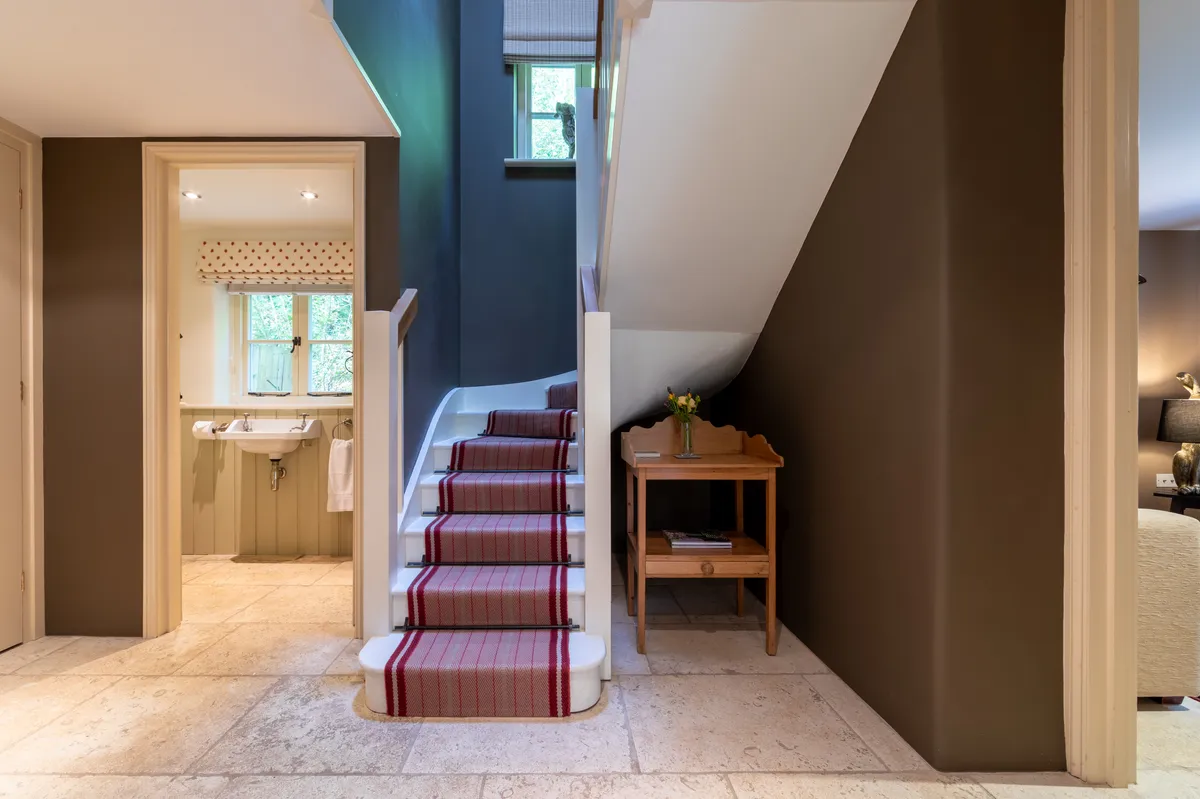
Not every property has a spare room, but many have an alcove, under-stairs space, or landing area that could work as a desk space. These are worth photographing because they show potential, a buyer who works from home two days a week doesn't necessarily need a full room.
Staging tip: A small desk, a task lamp, and a laptop are all you need. The photo should show that the space is functional and well-lit, even if it's compact.
The Loft Conversion
Loft offices are increasingly popular, offering separation from the main living areas. The challenge is photographing the sloping ceilings without making the space feel cramped.
My approach: I shoot from a low angle to emphasise the height at the apex, and I position the desk where the ceiling is highest. Velux windows or dormers provide excellent natural light for a workspace, and I make sure to include them in the frame.
04Preparing Your Home Office for Photography
Here's my specific checklist for home office photography:
Essential preparation: - Clear the desk completely, then add back only: laptop/monitor, keyboard, mouse, one plant or desk lamp - Hide all cables, use cable ties, management trays, or simply tuck them behind furniture - Remove all personal items, family photos, children's artwork, personal mail - Clean the monitor screen (it shows in photos) - Tidy bookshelves, remove clutter, arrange books neatly, add a few decorative items - Ensure the desk chair is clean and positioned neatly
Bonus touches: - A small plant or succulent on the desk adds life - A quality desk lamp suggests good task lighting - An open notebook with a pen suggests productivity - Fresh flowers on a side table add colour and warmth
05For Estate Agents: Making the Most of Home Office Features
If you're an estate agent listing a property with a home office, here's how to maximise its impact:
- 1.Lead with it, If the property has a dedicated home office, consider making it one of the first 5 images in the listing. Remote workers will be scanning for it.
- 1.Label it clearly, Don't just call it "Bedroom 4." Label it "Home Office / Study" in the listing. This helps it appear in filtered searches.
- 1.Mention the details, Fibre broadband, ethernet ports, good mobile signal, quiet location, these are all selling points for remote workers.
- 1.Show the commute, If the property is near a train station for hybrid workers, mention the commute time to Bristol, Bath, or London. Many buyers in Somerset are hybrid workers who commute 2-3 days per week.
06For Landlords: Home Office as a Rental Premium
Properties with a dedicated workspace command a rental premium. According to Zoopla, rental properties marketed with a home office feature achieve 8-15% higher rents than comparable properties without one.
If you're a landlord considering how to add value to your rental property, converting a spare room into a dedicated office space, with a desk, good lighting, and ethernet connectivity, is one of the most cost-effective improvements you can make.
07The Future of Home Office Photography
As remote and hybrid working becomes further embedded in UK work culture, the importance of home office photography will only grow. I'm already seeing a shift in how estate agents brief me, five years ago, a spare bedroom was always photographed as a bedroom. Now, agents increasingly ask me to stage and photograph it as an office.
The properties that sell and let fastest are the ones that show buyers and renters exactly how they'll live and work in the space. A well-photographed home office does exactly that.
Need your property's workspace photographed professionally? I cover Bristol, Bath, Somerset, and the wider South West. Get in touch or call 07545 450543 for a quote.
--- I provide professional property photography across Somerset, Bristol and Bath. Get in touch or call 07545 450543 to discuss your project.